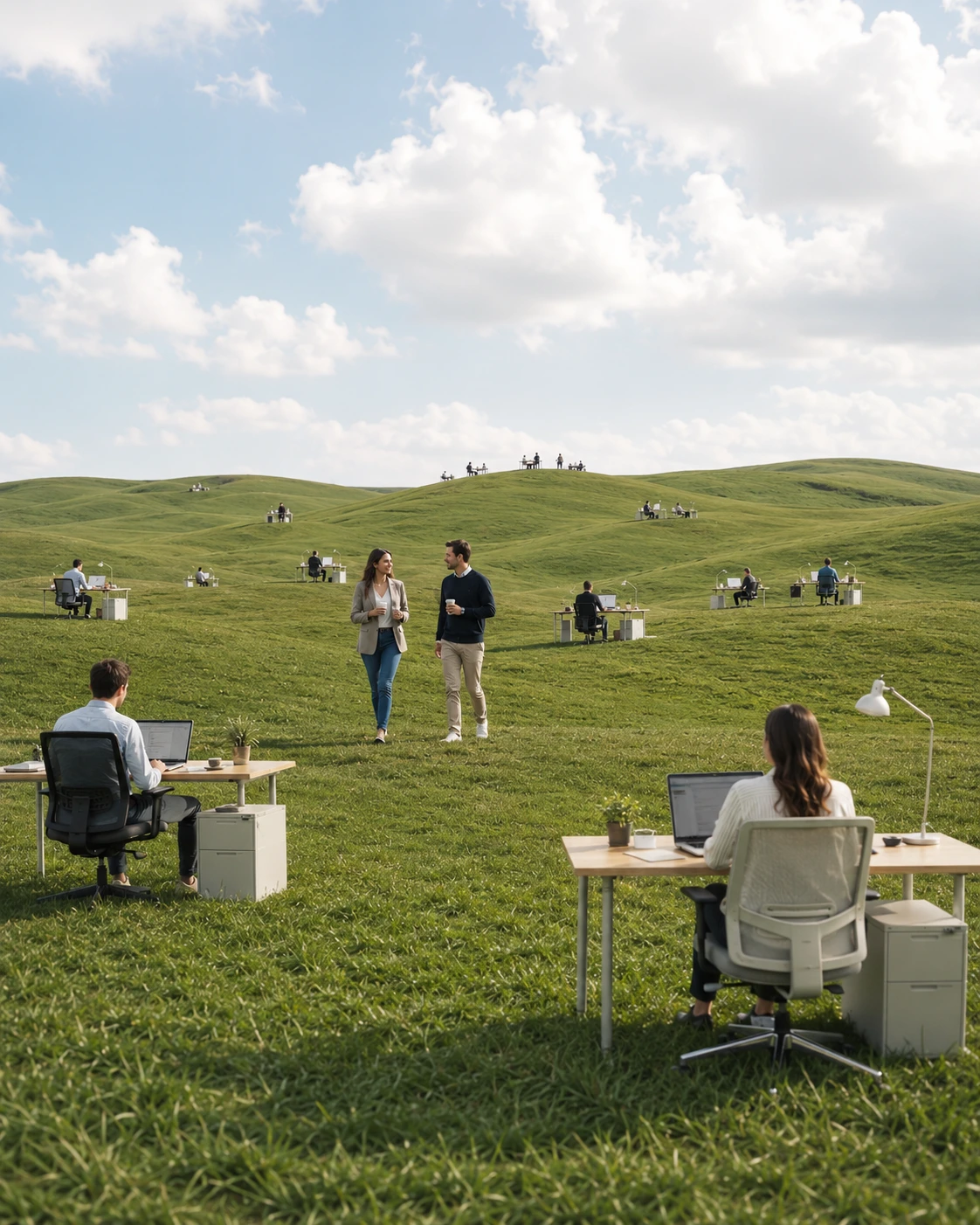



















We call it flexibility. Often, it’s just chaos.
Remote, hybrid, in-person: Each model promises the best.
None of them answers the real question.

"Something's not right here," I thought the other day. It was a Tuesday evening, half past seven. I was sitting at the kitchen table—which has also been my desk for the past two years—and quickly replying to a Slack message. My daughter asked from the sofa if I'd be done soon. My answer: "Just a minute." That "minute" turned into an hour.
I’d actually stopped working at five that day. It’s just that my laptop somehow hadn’t caught on. This is the side of working from home that’s rarely talked about—not the free, flexible, self-directed work, but the kind that just never ends.
Three Companies, Three Answers
Atlassian
Atlassian, the Australian software giant behind Jira and Trello, has a clear answer: No one has to come into the office. Instead, the entire team meets four times a year—for the things that can’t be done remotely: face-to-face interactions, casual conversations, and eating together. The result: Team cohesion remains elevated for several months, and the acceptance rate for job offers has risen by 20 percent.
Spotify
Spotify takes a different approach. Employees decide each year where they want to work. The offices are not mandatory workspaces, but rather voluntary collaboration hubs. Once a year, the team comes together for a mandatory “Core Week” to discuss strategies and reconnect with one another. The result: a 15 percent reduction in employee turnover.
GitLab
GitLab represents the other extreme: fully remote, with 1,500 employees in 65 countries. What keeps collaboration going, however, is one ironclad rule: Every decision is documented. Important information belongs in the documentation, not in a chat history that no one can find later. This creates clarity, even when no one is working in the same location.
Three models, three approaches. They all work not because they arose by chance, but because someone decided what collaboration should look like and built structures to support it.
The real problem isn't shown on any map
You can spread a team across the globe, and it works. And you can have a team sitting in the same office, and it still doesn't work. Location isn't the problem.
What’s missing are clear guidelines. When am I available, and when am I not? Which decisions require a conversation, and which ones can be handled with a message? What happens if, while working remotely, I miss something that was decided elsewhere during lunch?
A study by the Fraunhofer Institute shows that over 70 percent of respondents observe negative effects among their employees due to the blurring of work and personal boundaries. The laptop at home is never turned off, and the Teams channel is always open. The workday only ends when you make it end. And those who don’t set clear boundaries often fail to do so.
That's the kind of stress people rarely talk about. Not the loud, obvious kind. But that underlying feeling of never quite being done. Of still being a little bit caught up in it.
“You only get to call it a day if you make it happen.”
What Nobody Teaches You
What surprised me most about hybrid work was how unprepared I was to manage myself. The office provides structure. At home, that’s gone. Suddenly, you have to decide for yourself when to take a break, when you’re available, and when you’re not. When you simply won’t reply to a Slack message at 7:30 p.m., even if your laptop is still open in front of you.
This isn't something that comes naturally. It's a skill. The same goes for leaders. Anyone who leads a hybrid team must learn to maintain a presence even from a distance—not by sending more messages, but by being clear—and by recognizing that the people you can't see still want to be led.
Team spirit doesn't develop in a Slack channel
What’s missing most in a hybrid work environment is the human connection. The quick question on the way to the coffee machine. Lunch, when you find out what’s really on a colleague’s mind. That can’t be translated one-to-one into the digital world. But you can consciously create space for it: days in the office that aren’t packed with appointments, and rituals that foster connection even when working remotely.