Hybrid learning: Strategically combining face-to-face and digital learning


Remote work, decentralized teams, and digital transformation pose new questions for human resources development: How can employees learn effectively when they work in different locations? Which formats promote sustainable learning transfer? Hybrid learning is not a compromise solution, but rather the ideal approach for modern skills development.
Hybrid learning: The most important facts in brief
- Hybrid learning strategically combines face-to-face and digital learning: the formats alternate over time and build on each other—for example, e-learning for preparation, face-to-face workshops for consolidation, and online coaching for follow-up.
- The biggest advantages are greater flexibility, reduced travel times, and more sustainable learning transfer.
- Four pillars determine success: technology as a basis, well-thought-out teaching methods for effective learning processes, active support from learning guides, and an appreciative corporate culture are indispensable.
- From needs analysis and didactic design to the selection of suitable tools and ongoing support—hybrid learning paths require systematic planning.
- Hybrid learning combines the strengths of both worlds: digital formats create flexibility and allow students to learn at their own pace, while face-to-face sessions enable exchange and practical consolidation.
What is hybrid learning?
Hybrid learning refers to the strategic combination of in-person and online learning formats into a well-designed learning journey. In the context of corporate continuing education, the term is used synonymously with “blended learning.” The core concept: Different learning formats are deliberately combined and integrated from a pedagogical perspective so that they reinforce one another.
Hybrid learning vs. HyFlex model
Hybrid learning must be distinguished from the HyFlex model. Although both approaches combine face-to-face and digital learning, they differ fundamentally in their conception.
The building blocks of hybrid learning models
Hybrid learning is more than just a mix of methods—it systematically combines different forms of learning. Two central components form the foundation of successful hybrid concepts.
1. Synchronous & asynchronous learning phases
The combination of synchronous and asynchronous phases creates flexibility while maintaining a structured learning framework.
- Synchronous learning takes place together at the same time. Face-to-face workshops, In-house training, live webinars, or virtual group work provide space for direct exchange and enable immediate feedback. This is where relationships are formed, questions are clarified immediately, and complex topics are worked on together.
- Asynchronous learning is individualized and flexible in terms of time. E-learning modules, instructional videos, learning nuggets, reading assignments, and online forums allow learners to choose their own pace and repeat content as needed. These formats are particularly suitable for knowledge building and self-directed consolidation.
2. Self-directed & guided learning
The right balance between freedom and leadership determines success.
- Self-directed learning promotes personal responsibility and self-learning skills—abilities that are indispensable in today's dynamic working environments.
- Guided learning provides structure through learning guides or trainers who provide targeted training and actively support the learning process.
The appropriate ratio depends on the target group, the topic, and the learning objectives.


Benefits of hybrid learning for companies
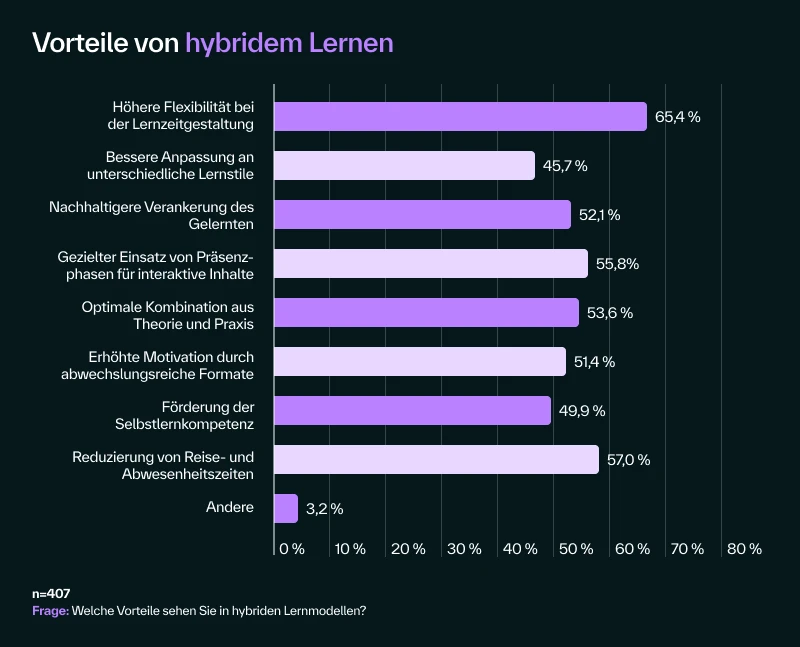
Hybrid learning pays off for both the company and its employees. The benefits go far beyond cost savings. The surveys on hybrid learning models in the BENCHMARKING Study 2025 support these benefits with concrete figures.
Effectiveness & Sustainability
Hybrid learning promotes greater knowledge transfer through practical phases, repetition, and time distribution. Employees apply what they have learned directly in their everyday work and consolidate it in reflection phases. The BENCHMARKING study shows that 52.1% of companies with hybrid learning models perceive a more sustainable anchoring of what has been learned.
Flexibility & Scalability
Learning takes place independently of time and place and efficiently reaches large target groups. Employees train themselves in their home office, on the road, or at the company location, which allows them to better organize their learning times and better coordinate their work processes. The study shows that 65.4% of the companies surveyed consider flexibility to be the greatest advantage.
Economic efficiency
For 57% of companies, reducing travel and absence times is one of the key advantages of hybrid learning models. Resources are conserved, while it becomes easier to integrate hybrid models of continuing education into everyday life. Investments in digital content pay off in the long term.
Individualization
Tailored learning paths for different needs, prior knowledge, and learning styles enable targeted upskilling and reskilling. Within the study, 45.7% highlight better adaptation to different learning styles as an important added value.
Modern learning culture
The integration of digital and face-to-face formats promotes personal responsibility, self-directed learning, and lifelong learning. According to the study, more than half of companies (51.4%) have observed increased motivation as a result of varied formats.
Why hybrid learning is more effective than purely digital or purely analog approaches
Hybrid learning combines the strengths of both worlds: digital formats teach the basics in a flexible manner and allow for individual learning speeds. Face-to-face sessions reinforce what has been learned through discussions, role-plays, and practical exercises. This combination promotes sustainable learning transfer and actively engages employees—without the disadvantages of exclusively digital or exclusively face-to-face formats.
Successfully designing hybrid learning paths
An effective hybrid learning process does not happen by chance; it follows a clear didactic design. Four steps lead to successful learning journeys.
Step 1: Needs analysis & goal definition
The first step is for the company to clarify its goals and target audience. What should be different at the end? What skills should be developed? Analyze the learners' prior knowledge, learning habits, and technical equipment. Formulate measurable learning objectives and clarify the framework conditions such as time, budget, and available resources.
Step 2: The right mix for instructional design
The trick lies in interlinking the formats. It's not simply a matter of "online + face-to-face," but rather a well-thought-out learning journey in which each phase builds on the previous one.
Example: Hybrid learning path for management development
- Phase 1 (asynchronous): Online kick-off and e-learning provide the theoretical foundation. Learners acquire basic knowledge at their own pace.
- Phase 2 (synchronous/face-to-face): Intensive workshops provide space for role-playing, case studies, and practical applications. Leadership situations are practiced and reflected upon in direct exchanges.
- Phase 3 (asynchronous/guided): Transfer tasks in your own everyday work can be implemented with peer coaching and microlearning. Managers put what they have learned into practice and exchange ideas in the learning group.
- Phase 4 (synchronous/online): The virtual final webinar provides an opportunity to share experiences and consolidate results. Successes are highlighted and challenges are addressed together.
Step 3: Select content and tools
Decide how you want to deliver your learning content: You can either create your own learning content or use ready-made course libraries from third-party providers. Based on that, choose the right technology: A Learning Management System such as LMS Haufe AkademieLMS handles administration and tracking, while a Learning Experience Platform (LXP) enables personalized learning experiences. Collaboration tools promote social learning and knowledge sharing.
Step 4: Communication & Participant Management
Clear communication about the process, expectations, and benefits provides guidance. Support learners continuously through all phases. Learning facilitators ensure motivation and commitment. Provide technical support as needed.
Challenges of hybrid learning
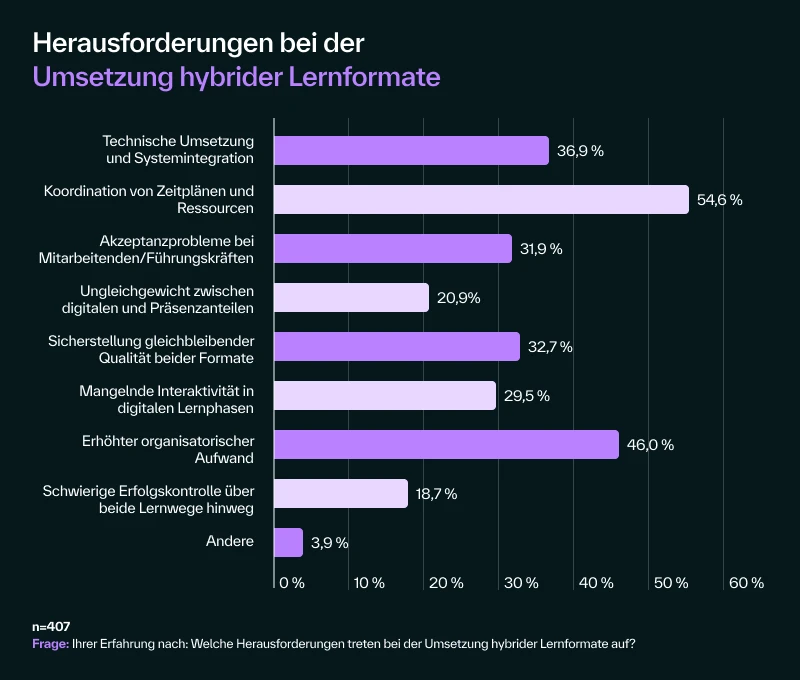
Hybrid learning poses particular challenges for companies and does not automatically run smoothly.
Typical hurdles are:
- technical barriers due to a lack of infrastructure or digital skills,
- low self-learning skills among employees,
- cognitive overload due to too many different formats
- as well as a lack of learning culture and time resources.
4 pillars of successful hybrid concepts
Four pillars represent the success factors that determine success or failure:
- Technology: Learning Management Systems (LMS), Learning Experience Platforms (LXP), and collaboration tools form the technical basis for organization, provision, and exchange. Stable technical integration into existing systems is essential for smooth processes.
- Didactics: A poor face-to-face seminar will not improve digitally—it requires well-thought-out instructional design that combines the formats to create effective learning processes. Formats must be coordinated in terms of content and methodology. The way you teach and convey content determines its effectiveness.
- Support: Learning guides and community management maintain motivation and ensure that learning is transferred into practice. Learning guides answer questions, moderate discussions, and keep the learning process moving forward. Without active support, motivation declines and what has been learned remains abstract.
- Corporate culture: Commitment from management, freedom for employees to learn, and appreciation for continuing education are key prerequisites. A learning culture in which learning is seen as an investment is indispensable.
The future of corporate learning is hybrid
Future developments include AI-driven personalization of learning paths to enable more targeted learning opportunities. Microlearning and “learning in the flow of work” are gaining importance, and learning is becoming an integral part of work. The link between learning and performance management and talent development is growing stronger. As a strategic response to New Work and digital transformation, hybrid learning is characterized by flexibility and effectiveness.
Successfully implementing hybrid learning concepts
With decades of experience in human resources development, Haufe Akademie supports Haufe Akademie in designing effective hybrid learning concepts. Our 360° Corporate Learning accompanies you from strategy and conception to implementation. We offer flexible, tailor-made solutions for companies of all sizes, combining didactic expertise, extensive content libraries, and modern technology. Working in partnership with you as equals, we develop learning architectures that deliver measurable ROI and sustainable learning transfer.
Discover 360° Corporate Learning now
FAQ
What is the difference between hybrid learning and blended learning?
In the context of continuing vocational training, both terms are used synonymously. Both describe the strategic combination of face-to-face and online learning formats to create a well-thought-out learning journey. In school and university education, "hybrid learning" sometimes also refers to the HyFlex model, which can be distinguished from hybrid learning and blended learning, however, as it involves simultaneous on-site and online participation.
What technical requirements does hybrid learning need?
For successful hybrid learning, you need a Learning Management System LMS) for organization and administration, ideally supplemented by a Learning Experience Platform LXP) for personalized learning experiences. In addition, collaboration tools for synchronous phases and a stable technical infrastructure are required for learners.
What are some examples of hybrid learning?
Typical hybrid learning formats combine various elements: An onboarding program starts with e-learning modules on corporate culture, followed by a face-to-face workshop to get to know each other. Leadership development combines webinars on leadership theories with practical workshops and subsequent transfer tasks in everyday work. Compliance training uses online tests to assess knowledge and deepens critical topics in face-to-face discussions.
How can I motivate employees to engage in self-directed learning?
Create a learning culture in which continuing education is valued. Communicate the specific benefits for employees and provide clear structures and guidance. Offer choices in terms of content and formats, and allow sufficient time for learning. Learning support and community interaction further increase motivation.
You might also be interested in