Learning effectively with microlearning


A puzzle consists of many small pieces—just like sustainable learning. Microlearning relies on compact units of knowledge that gradually come together to form a larger whole. Short learning units are available at any time, easy to understand, and directly applicable in everyday life. Here you can find out why microlearning is so effective and how you can use it specifically for yourself or your team.
Microlearning: The most important facts in brief
- Microlearning imparts knowledge in short learning units that can be accessed flexibly, without approvals, and exactly when needed. These learning nuggets focus on a specific topic, enable situational learning at the moment of need, and can be seamlessly integrated into everyday work.
- Videos, quizzes, infographics, podcasts, and interactive elements appeal to different learning styles. The more sensory channels are used, the better the knowledge sticks. Regular repetition in different formats ensures lasting learning success.
- Companies benefit from cost efficiency, scalability, reduced downtime, and accurate performance measurement. Employees learn independently, apply what they have learned immediately, and continuously expand their skills.
- AI algorithms create personalized learning paths and enable true dialogue-based learning in a work context through new AI-powered learning formats such as "MicroStory" and "MicroTool."
- Microlearning is most effective when combined with blended learning. Short units are ideal for rapid knowledge transfer and performance support, while complex topics are explored in greater depth through face-to-face formats.
- Company-specific content is best created in-house, while interdisciplinary topics are purchased cost-effectively. In practice, a combination of both strategies has proven successful.
What is microlearning?
Microlearning describes a learning method in which knowledge is imparted in short, focused units lasting between 2 and 15 minutes. Essentially, it involves breaking down complex content into small, digestible chunks – known as learning nuggets. These learning units are self-contained, focus on a specific topic, and can be accessed flexibly. This makes them ideal for quick knowledge transfer in between tasks and needs-based learning at the moment of need.
In a business context, this means that videos, exercises, checklists, and audio files provide quick, practical support in everyday work. Supplementary knowledge tests ensure learning success and make the level of knowledge transparent. The content is application-relevant and practical, so that what has been learned can be implemented immediately.
The forgetting curve according to Ebbinghaus - the basis of microlearning
As early as the 19th century, psychologist Hermann Ebbinghaus discovered how quickly people forget new knowledge. His so-called forgetting curve shows that our memory declines rapidly after only a short time—the extent of this decline varies depending on the content, but it is always significant.
An efficient tactic to counteract this effect is repetition. This is exactly where microlearning comes in: Knowledge is taught in small units and repeated regularly - often in different formats. In this way, it is better remembered and learning success increases in the long term.
However, Ebbinghaus' model is not without controversy: his experiments were based on meaningless syllables and a single test subject (himself). Today, we know that memory depends on many factors, such as prior knowledge, emotions, and learning strategies. The microlearning method is based on the principle of repetition, but goes beyond it. Through targeted, everyday learning units, knowledge not only remains accessible for longer, but is also better understood and applied.
Why is microlearning important? The benefits for companies
Technological developments, new business models, and changing customer expectations require companies to continuously adapt. Traditional training formats are increasingly reaching their limits: they are often time-consuming, costly, and difficult to integrate into everyday work. Microlearning offers a modern solution. The short, focused learning units can be seamlessly integrated into everyday work and enable learning exactly when it is needed. Microlearning expands learning opportunities in an intuitive way: employees can access learning content with just a few clicks.
The BENCHMARKING Study 2025 also shows that this form of learning is gaining in importance. Companies were asked which developments in the next three to five years could have the greatest impact on target achievement and ROI in human resources development.
Microlearning is one of the most frequently mentioned trends, cited by 60% of respondents—a clear indication of its relevance for modern learning strategies.
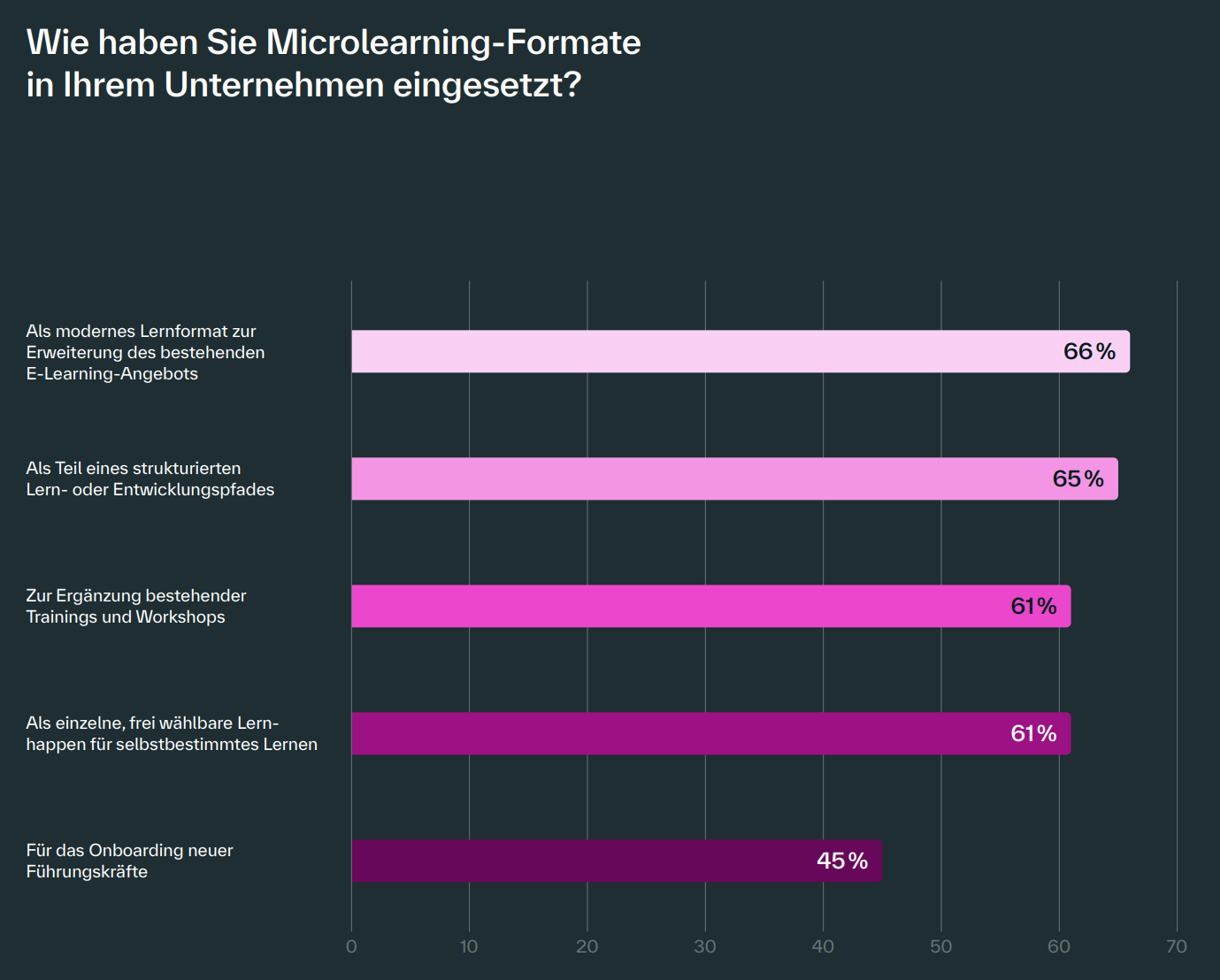
In a recent study on microlearning, 200 HR experts shared experts experiences with the use of microlearning in their organizations. The companies surveyed primarily use microlearning to expand their existing e-learning offerings with a modern learning format (66%); they also frequently incorporate it into structured learning or development pathways (65%). Common scenarios in practice also include training sessions and workshops where microlearning is used to supplement existing content (61%) and as individual, freely selectable “learning bites” for self-directed learning (61%).


How microlearning works in companies – a practical example
Imagine you have to step in at short notice for a colleague who is ill during an important presentation. But she was the expert, and you have little experience in creating and giving presentations. How can you get started quickly and effectively? How can you stay on track and convey the information in an exciting way without boring your audience? Traditional training help—but you don't have time for that. You start familiarizing yourself with the topic and search online for tips and tricks. But you quickly realize that your research is not focused and the deadline is getting closer and closer. The stress is growing, and you are unsure whether you can meet the requirements of the presentation.
This is where microlearning comes in. It's a learning format that provides you with the knowledge you need in a short amount of time and from anywhere—without a lot of effort or formal application. Short videos or practical exercises give you the necessary impetus to master your presentation. You use the time you have available and learn exactly what you need for your task – for example, how to structure a presentation, engage your audience, and deliver it confidently. The result: you go into the presentation feeling confident, able to apply the most important techniques, and having acquired the necessary knowledge in a very short time.
What formats are available in microlearning?
Microlearning covers a wide range of different formats that appeal to different learning types. These can be text- or audio-based, as well as visual—but they can also be interactive or gamified.
Text-based formats
Short, concise text snippets and learning prompts on a specific topic or a concrete practical case form the basis. These include tips, checklists, or step-by-step instructions. Information is often packaged in stories or illustrated with small case studies to make it more tangible.
Visual formats
Infographics present complex issues in a way that is easy to understand at a glance. Short educational videos—whether expert input, animations, or screencasts—convey knowledge in a clear and entertaining way.
audio formats
Short podcasts or interview excerpts are ideal for listening to on the go. They can be consumed while commuting, exercising, or during lunch breaks, making use of times when visual learning is not possible.
Interactive formats
Quiz questions and gamification elements engage users and encourage active engagement with the learning material. Simulations, such as role-playing exercises, allow for practical practice in a safe environment. Interactive videos, on the other hand, present decision points at specific points or ask questions that guide the learning process. AI-powered formats go one step further: they respond in real time to learners’ decisions and inputs, making every learning experience unique.
These formats are often combined alternately to create a memorable learning experience. The more sensory channels and learning formats are used in learning (also known as multimodal learning ), which encourage reflection and application, the better the knowledge is retained. Today an interactive video, tomorrow a social learning opportunity that promotes exchange, and then an auditory learning format that encourages reflection. This creates varied learning sequences that encourage reflection, application, and further thinking.
Microlearning vs. traditional learning formats: A comparison
To understand when which format is appropriate, a comparison is helpful:
The strength lies in the combination: microlearning is ideal for rapid knowledge transfer, refresher courses, and performance support in everyday working life. Complex topics that require intensive discussion or in-depth reflection remain the domain of face-to-face formats or detailed e-learning courses. The sensible mix—known as blended learning or hybrid learning —exploits the advantages of all formats, thereby creating lasting learning success.
What are the advantages of microlearning?
The advantages are evident for Learners companies. Employees receive direct support in their daily tasks, learn new things, and thus increase their own market value. The company benefits from qualified employees who perform their tasks more efficiently and contribute to its success with fresh ideas. These advantages explain why microlearning is so successful.
Advantages for Learners
- Flexibility and self-management: Learning Nuggets are available on mobile devices and can be used during breaks, on the way to work, or shortly before important appointments (m-learning). Learners for themselves when and where they want to learn—without approvals or long planning cycles. In addition, the many small units allow the content to be tailored more precisely to the maturity level and learning status of the employees.
- Optimal learning transfer and high motivation: What has been learned can be applied immediately, which facilitates transfer to the work environment and increases motivation. A wide range of choices and interactive, multimedia formats provide variety and promote learning motivation.
- Sustainable knowledge retention: Acquiring and consolidating knowledge is more successful when it is broken down into small steps and repeated regularly. Integrating this into your daily work routine ensures sustainable learning—without continuing education being perceived as a source of stress.
- Low barrier to entry: Just a few minutes of investment significantly lower the inhibition threshold. "I don't have time for further training" becomes "I'll just take a quick look." This low barrier promotes continuous learning.
- Continuous skills development: By regularly using small learning units, employees systematically develop their skills—without large learning blocks, but steadily and sustainably.
Advantages for companies
- Cost efficiency and scalability: Once created, learning nuggets can be used as often as desired—without additional trainer costs, travel expenses, or room rentals. Scaling is virtually free of charge.
- Less downtime: Since employees are not absent for entire days due to training or similar activities, productivity is maintained. Further training takes place in small steps alongside regular work.
- Precise measurement of success: Like other online learning offerings, microlearning offers the possibility of better measuring success (for example, through quiz results or completion rates).
- Quick adaptability: Microlearning content can be quickly and centrally adapted for everyone. All employees automatically receive the updated version, enabling companies to ensure consistent standards.
- Measurable ROI effects: The combination of lower costs, shorter downtime, and faster applicability ensures that investments in microlearning pay off more quickly than with traditional formats.
Make or buy? Contents for microlearning
The learning content for a microlearning approach can be created in-house or purchased and made available on suitable platforms. Whether to "make or buy" depends largely on the type of content and the resources available. The microlearning study showed that 59% of the companies surveyed combine in-house productions with ready-to-use modules.
Make: Create company-specific content yourself
When it comes to presenting internal processes or knowledge about specific products and services offered by your company, it is best to create these yourself. This guarantees that the nuggets are highly relevant, flexible in terms of customization, and gives you control over the didactics and design.
Buy: Efficiently purchasing interdisciplinary content
Interdisciplinary content can be purchased efficiently and in a time-saving manner. Soft skills topics such as time management or communication, IT basics such as cybersecurity or basic AI knowledge, compliance training, or leadership topics are suitable for this purpose. This content is standardized, high-quality, and ready for immediate use.
In practice, a combination often proves successful: company-specific topics are developed internally, while professional providers are used for general skills.
Who is microlearning suitable for?
Whether you are a career changer, a young professional, or a senior expert, videos, infographics, and podcasts provide quick answers to everyday questions. Microlearning works for all career levels and learning types.
- Employees use Learning Nuggets for quick help in their everyday work—for example, to prepare for virtual meetings, learn about new software features, or deal with unexpected challenges.
- Managers and subject matter experts use microlearning as a refresher or to obtain specific input for situations outside their daily routine—for example, before an important feedback meeting or when new compliance requirements arise.
- HR developers are using microlearning to flexibly expand their continuing education offerings and design customized learning journeys that can be combined with in-person and online formats.
Trends: AI in microlearning
Artificial intelligence is changing the way we learn—and microlearning stands to benefit greatly from this. According to the mmb Monitor 2024/2025, 93% of experts AI applications to become a standard part of everyday education in the coming years. We are already seeing what this means in practice today.
AI as a personal learning companion
Traditional learning paths treat all learners the same, whereas AI-powered systems do not. Algorithms analyze each learner’s individual level of knowledge and learning behavior and continuously adapt the content:
- Students who are struggling will receive additional support.
- Players who make quick progress will receive more challenging nuggets.
Chatbots and virtual learning assistants round out the offering, are available around the clock, and recommend relevant content. AI also significantly speeds up content creation: texts, graphics, and short videos can be produced much more quickly.
Learning Through Dialogue: MicroStory and MicroTool
AI-powered learning formats go beyond mere personalization: they transform learning into a genuine dialogue. Learning is most effective when it is directly linked to one’s daily work routine. This is exactly where Haufe Akademie AI formats come Haufe Akademie :
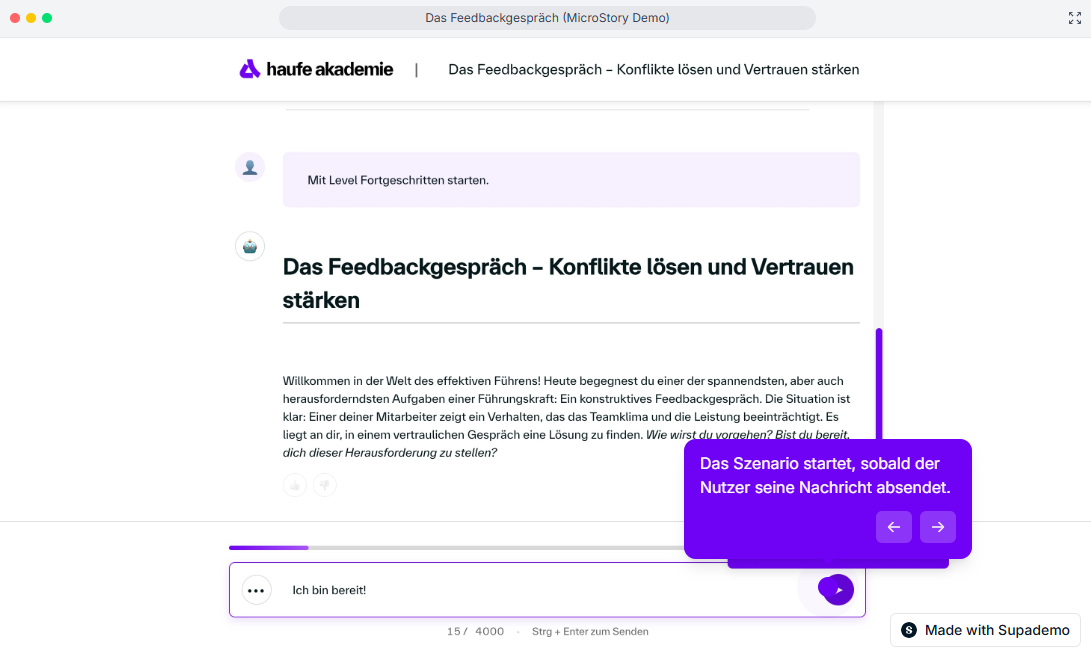
- MicroStory: Learners are immersed in a realistic, AI-driven scenario (such as a challenging team discussion) and are free to make their own decisions. The AI adapts the story in real time, creating a learning experience that feels different from traditional simulations with predetermined paths.
- MicroTool: Learners apply a specific method—such as SMART goals—directly to their own current work project. The AI guides them through the process with explanations tailored to their needs and adapts to their individual situation. Here, learning and work merge into a single process.
“I really liked the dialogue because I could easily picture the situation, and it felt almost real since you don’t know exactly what’s coming.” (participant, MicroStory feedback session)
Using AI responsibly
The possibilities offered by AI are vast, and so is the responsibility. Data protection, algorithmic transparency, and the prevention of bias remain key issues in the use of AI in education. experts that AI-generated content and recommendations should be reviewed regularly. The EU AI Regulation establishes an important regulatory framework for this purpose. The future of microlearning is AI-driven, dialogue-based, and personalized.
Haufe Akademie: Your partner for microlearning solutions
Haufe Akademie you in strategically and sustainably embedding microlearning in your company. We combine expertise with modern learning technologies. The Content Kit you access to more than 2,000 high-quality microcontents from various subject areas, inspired by everyday challenges in professional life. Whether communication, leadership, AI skills, or project management: smart filter options allow you to quickly find the right learning nuggets and create individual learning paths in just a few clicks. Integrate them into company-specific learning scenarios, expand existing Development Programs enable performance support in the moment of need—easily, flexibly, and effectively.
As a corporate learning partner who works with you as an equal, we support you every step of the way—from needs analysis and implementation to the ongoing optimization of your microlearning strategy. All of our Learning Nuggets are designed by our experts to meet the highest experts and can be seamlessly integrated into your existing learning environment. Our goal: to prepare your employees for the future—with training that truly makes a difference.
FAQ
How long does a microlearning unit last?
A microlearning unit typically lasts between 2 and 15 minutes. The optimal length is 3 to 5 minutes – short enough to fit in during breaks or between meetings, and long enough to achieve a specific learning goal. The duration depends on the topic and format: a quiz can be completed in 2 minutes, while a video that requires explanation is more likely to take 5 to 10 minutes.
Which topics are suitable for microlearning?
Microlearning is particularly suitable for topics that can be divided into small, focused units. These include soft skills such as communication or time management, compliance training, IT basics and cybersecurity, product training and process knowledge, leadership skills, and language training. Less suitable are highly complex topics that require intensive reflection or longer practical exercises—more detailed formats are the better choice here.
Is microlearning replacing traditional continuing education?
No, microlearning does not replace traditional continuing education, but rather complements it in a meaningful way. Complex topics that require in-depth discussion, exchange, or practical practice remain the domain of face-to-face seminars or more comprehensive e-learning courses. Microlearning scores particularly well when it comes to rapid knowledge transfer, refresher training, and performance support in everyday work. The combination of both approaches—known as blended learning—delivers the best results.
How do I measure the success of microlearning?
The success of microlearning can be measured using various metrics: Completion rates show how many Learners work through Learners units. Quiz results provide information about the level of knowledge. Usage data reveals which content is particularly popular. A transfer measurement checks whether what has been learned is being applied in everyday work. Employee feedback provides qualitative insights into the relevance and quality of the content. A combination of these metrics provides a comprehensive picture of learning success.
Do I need a special platform for microlearning?
A learning platform such as an LMS Learning Management System) or an LXP Learning Experience Platform) is helpful, but not essential. These systems offer advantages such as centralised administration, analysis functions and mobile access. However, microlearning content can also be delivered via other channels – such as the intranet, Microsoft Teams or even by e-mail. The key thing is that employees can find the content quickly and easily.
You might also be interested in