
pds-all
['Form page','no']
Trend Radar 2026

Trend Radar –
The Skills of the Future

What skills will be in demand in the future? What new fields of work will emerge? The Zukunftsinstitut has Haufe Akademie these questions for the Haufe Akademie . The research findings will help you identify and understand the jobs and skills of tomorrow, and use that insight to make informed decisions for yourself and your organization.

Download Trend Radar

These fields of work will shape the future

The Trend Radar highlights the fields of work and the associated future-oriented skills that will become relevant in the coming years, categorizing them into four waves of urgency:
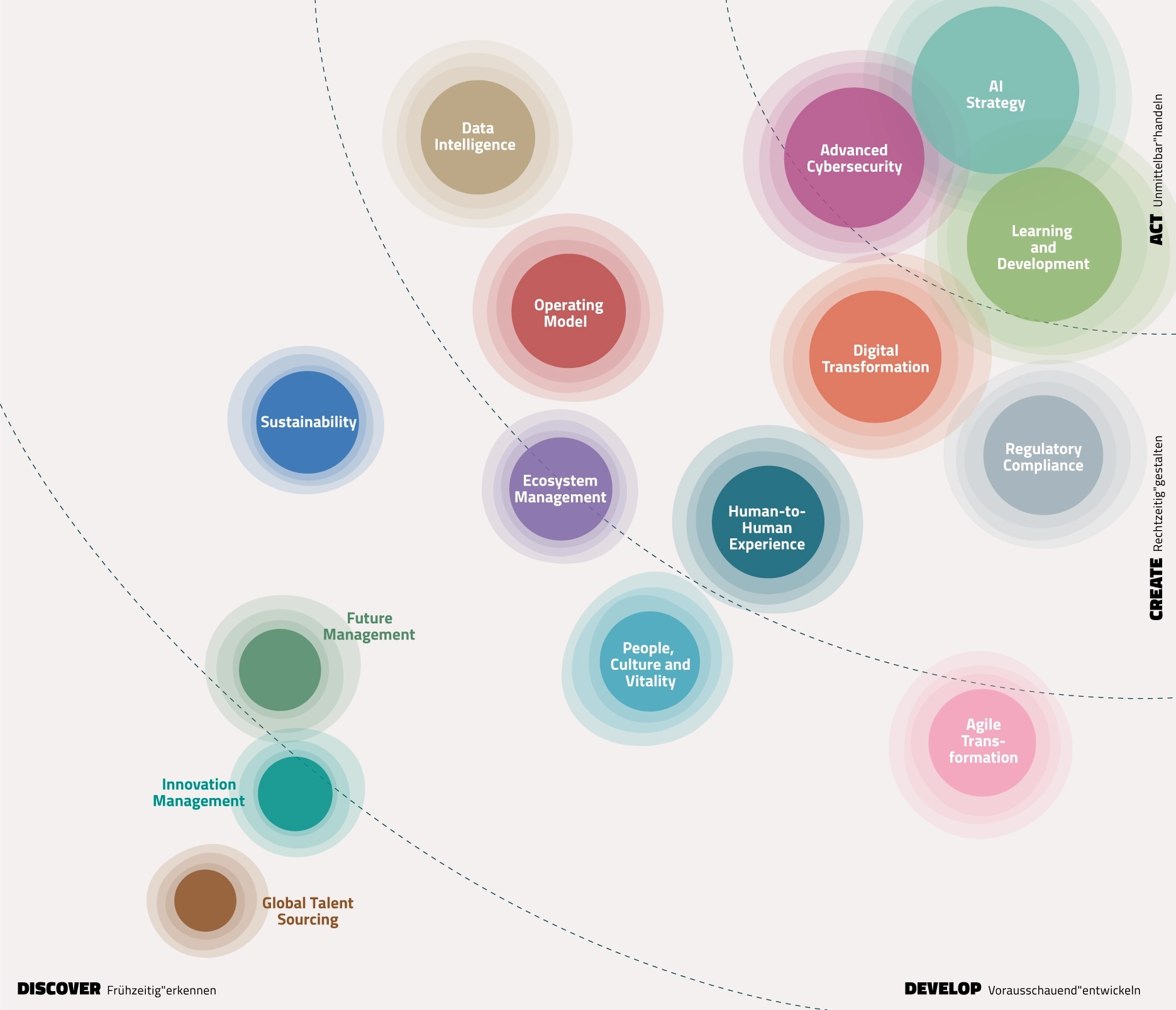
Act, Create, Develop, and Discover.

Trend radar

Created by

Trend Radar 2024 -
The Jobs of the Future

Download Trend Radar
FAQ

Frequently asked questions

What research findings can I find in Trend Radar?

The Trend Radar identifies 15 key organizational areas of focus that will be critical to the world of work in the coming years. It highlights specific shifts, such as the move of AI strategy into the immediate sphere of action or the new importance of cyber resilience.

A key finding is the analysis of evolving job profiles, which increasingly require a hybrid set of skills combining subject matter expertise, data literacy, and interpersonal skills. In addition, four new strategic areas—such as regulatory compliance and ecosystem management—are examined in detail. The findings make it clear that technological, cultural, and regulatory dynamics are now inextricably intertwined.

How do I read the Trend Radar?

The Trend Radar is a visual guide that ranks areas of focus according to their strategic urgency. This urgency increases from the bottom left to the top right, with the radar divided into four zones:

  • ACT: High urgency; requires immediate action.
  • CREATE: Strategic preparation and capacity building are necessary.
  • DEVELOP: Topics in forward-looking development.
  • DISCOVER: Fields with an exploratory nature.

The evaluation is based on four criteria: pace of change, structural impact, stakeholder needs, and the ratio of impact to effort.

Who might find the Trend Radar interesting?

The Trend Radar serves as a solid basis for reflection and discussion for the following key groups:

  • Management and executives who must make strategic decisions while under intense pressure to adapt.
  • Strategy leaders who want to identify future competitive advantages and build resilient organizations.
  • Professionals who want to actively prepare for the future early on and take a holistic approach to their professional development.
  • HR professionals and talent development specialists who design targeted programs for competency development and the creation of new skill profiles.

How do these research findings benefit me and my company?

The results provide a structured framework for setting priorities in a volatile work environment. Companies can identify early on where they need to build structures and capabilities to remain future-proof—for example, when scaling AI or ensuring regulatory compliance. The radar helps transform isolated individual topics into a connected, holistic view, thereby ensuring the organization’s ability to act. It also provides concrete guidance for creating healthy working conditions and an adaptive corporate culture. Ultimately, it facilitates informed discussions about necessary skill development, investments, and transformation processes.

What research methods were used in compiling the Trend Radar?

The creation of the Trend Radar is based on a four-step qualitative analysis process developed by the Zukunftsinstitut:

  • Relevance assessment: Existing areas of focus were reevaluated based on four defined criteria.
  • Triangulation: Each field was supported by 10 to 16 academic and practice-oriented sources drawn from a core corpus of 114 sources.
  • Blind-Spot Research: A systematic search for underrepresented topics using Opielka’s four social subsystems.
  • Integration: The identified gaps were weighted and incorporated into the model as four new areas of action.

Does the Trend Radar offer concrete guidance for leadership, workforce planning, and personal development?

Yes, the Trend Radar goes beyond a purely theoretical description of trends and identifies specific requirements for job profiles and skills in each field. It describes in detail how roles must evolve into hybrid profiles that combine, for example, subject matter expertise with AI proficiency, regulatory understanding, or systems thinking. As such, the Trend Radar serves as a practical tool for strategic competency development.

What are the main changes compared to the previous Trend Radar?

The 2026 Trend Radar reveals significant shifts: While topics such as AI Strategy and Cybersecurity have moved significantly into the “ACT” zone due to their urgency, Agility has been reevaluated. Particularly valuable are the four entirely new areas of focus—Regulatory Compliance, Operating Model, Ecosystem Management, and Human-to-Human Experience—which address strategic “blind spots.” These additions reflect a working world in which technological, regulatory, and cultural factors are inextricably intertwined.

About the Zukunfts-Institut

As a pioneer in trend and future research, the Zukunftsinstitut provides innovative ideas for the business world and offers consulting services, publications, keynote speeches, and professional development. With its Trend Radar, the Zukunftsinstitut has developed a data-driven navigation tool designed to provide an overview of future developments and help inform decision-making.
Download Trend Radar

*Mandatory fields
Two years, two radars, one clear picture.

Trend Radar 2024

In 2026, the question is: What skills do organizations need most urgently? A comparison of the two Trend Radars clearly shows how rapidly priorities are shifting: What was still in development in 2024 is already in the fast lane by 2026. The 2024 Trend Radar is thus more than just a historical document. It serves as a benchmark for gauging the pace and direction of change.

Download
