 4.8
4.8
Contents
The most important innovations of the planned amendment - cultural change in employment relationships?
Current legal situation regarding fixed-term contracts in the WissZeitVG
- Changes to the basic system of the WissZeitVG.
- Limitation of short-term contracts.
- Fixed-term contracts.
- Orientation points for the structuring of individual contract terms.
- Evaluation of the last amendment.
Operational area of application
- State and state-recognized universities.
- State research institutions.
- Predominantly state-run, institutionally predominantly state-run or research institutions financed on the basis of Article 91b of the Basic Law.
Employment relationships that are subject to the legal situation
- Newly concluded employment contracts.
- Scientific and artistic staff.
- Exceptions, including university lecturers.
- Private service contracts with members of a university.
Qualification and appropriateness
- Permissible time limit.
- What does "appropriate" fixed-term duration mean for the desired qualification?
- Problem area - qualification.
Further topics
- Time limit due to third-party funding.
- Fixed-term student employment contracts.
- Cases of imputation.
- Family policy component.
- Effects of the corona pandemic.
Overview of fixed-term contracts under the TzBfG in science
Learning environment
In your online learning environment, you will find useful information, downloads and extra services for this training course once you have registered.
Your benefit
- The training provides an overview of the planned amendment to the WissZeitVG and the current legal situation regarding fixed-term employment in the academic sector.
- You will learn how to act in accordance with the law in order to avoid costly and image-damaging disputes.
Methods
Lecture with case studies and time for individual questions and discussion in small groups.
Recommended for
employees of state and state-recognized universities, research institutions that employees scientific and artistic employees .
Furthermore, institutions that receive their financial resources exclusively or to a large extent from the federal and state governments or whose basic institutional funding is predominantly governmental.
Private service contracts with members of a university are also included.
The training is suitable for newcomers without prior knowledge.

Questions about the seminar content
Even minor errors in applying legal requirements can make fixed-term contracts legally vulnerable. That’s why it’s important to know which requirements must be met and what to look out for when drafting contracts. This training you training the relevant regulations and common pitfalls. This will give you greater confidence when making decisions about fixed-term contracts.
In practice, determining the appropriate contract term is often more challenging than expected. It should be possible to provide a clear rationale for the term, and it should be consistent with the relevant circumstances. In this training what guidelines can be used when determining contract terms. This will make decisions regarding contract duration more transparent.
Not every fixed-term contract in the academic sector can automatically be based on the WissZeitVG. The question often arises as to which employee groups and job functions are actually covered by the law. This training you training the basics for determining the personal and material scope of the law. This will make it much easier to assess the legal classification.
Academic qualification is one of the central aspects of the WissZeitVG. In practice, however, it is not always clear which requirements must be met and how qualification goals are taken into account. In training , you training the background and specific features of fixed-term contracts for qualification purposes. This will provide greater clarity on the requirements that must be met for a fixed-term contract based on qualification grounds.
Third-party-funded projects are usually time-limited and therefore involve specific requirements regarding fixed-term contracts. The question often arises as to what conditions must be met and how funding is taken into account. You’ll learn about the specific considerations that may come into play regarding fixed-term contracts in the context of third-party-funded projects. This will help you better understand the typical challenges in this area.
Student employment relationships consistently raise specific questions. These often concern the correct legal classification and the applicable options for fixed-term contracts. This training you the specific considerations that apply to student employees and what to keep in mind in practice. It will provide you with helpful guidance on how to manage this group of employees.
In practice, the legal basis for a fixed-term contract is often a decisive factor. Distinguishing between the WissZeitVG and the Part-Time and Fixed-Term Employment Act is therefore particularly important. In training about the key differences and areas of application. This will help clarify the legal consequences that may result from choosing one legal basis over another.
Many legal issues only become truly tangible when considered in the context of specific cases. That is why the training real-world examples and provides an opportunity for participants to ask individual questions. Discussing these issues with the seminar facilitators and other participants helps participants gain insight into different perspectives.
Anyone who deals with fixed-term contracts is regularly faced with questions from managers, employees, or other stakeholders. In training your understanding of the most important provisions of the WissZeitVG and their practical implications. This will make it easier for you to explain the issues clearly and answer questions with confidence.
3509
- Customized training courses
- Direct application in practice
- Efficient use of time and resources
Ratings and feedback from our participants

Start dates and details


Monday, 14.09.2026
09:00 am - 5:00 pm





Monday, 01.02.2027
09:00 am - 5:00 pm
- one joint lunch per full seminar day,
- Catering during breaks and
- extensive working documents.
Thursday, 11.03.2027
09:00 am - 5:00 pm
The next booking ensures this course will take place- one joint lunch per full seminar day,
- Catering during breaks and
- extensive working documents.
About us - The Haufe Akademie
Your optimizer, innovator and companion since 1978 -
Your professional partner for professional development and seminars, training courses and topical conferences.
Whether on site, live online or in-house - our customised solutions, our claim to the highest level of consulting expertise and training tailored to your needs simplify the acquisition of skills for the working world of the future and sustainably facilitate professional development.
A wide range of seminars, individual coaching and our flexible formats support HR managers and decision-makers in shaping the future and developing employees, in-house teams and companies.
Experience the benefits of online training from the comfort of your own home. Our online formats meet the highest quality standards and are in no way inferior to face-to-face events in terms of practical relevance. Learn together live online in interactive groups or digitally at a time of your choice.
Do you have any questions?
We are there for you Monday to Friday 8:00 a.m. - 5:00 p.m.

Questions & Answers
In our Questions & Answers (FAQ) section, you will find all the answers and the most frequently asked questions about your selected topic.

Munzinger Str. 9
79111 Freiburg

- Planning security
- Free seminar places
- Quality standards
- Planning and locations
- Funding opportunities
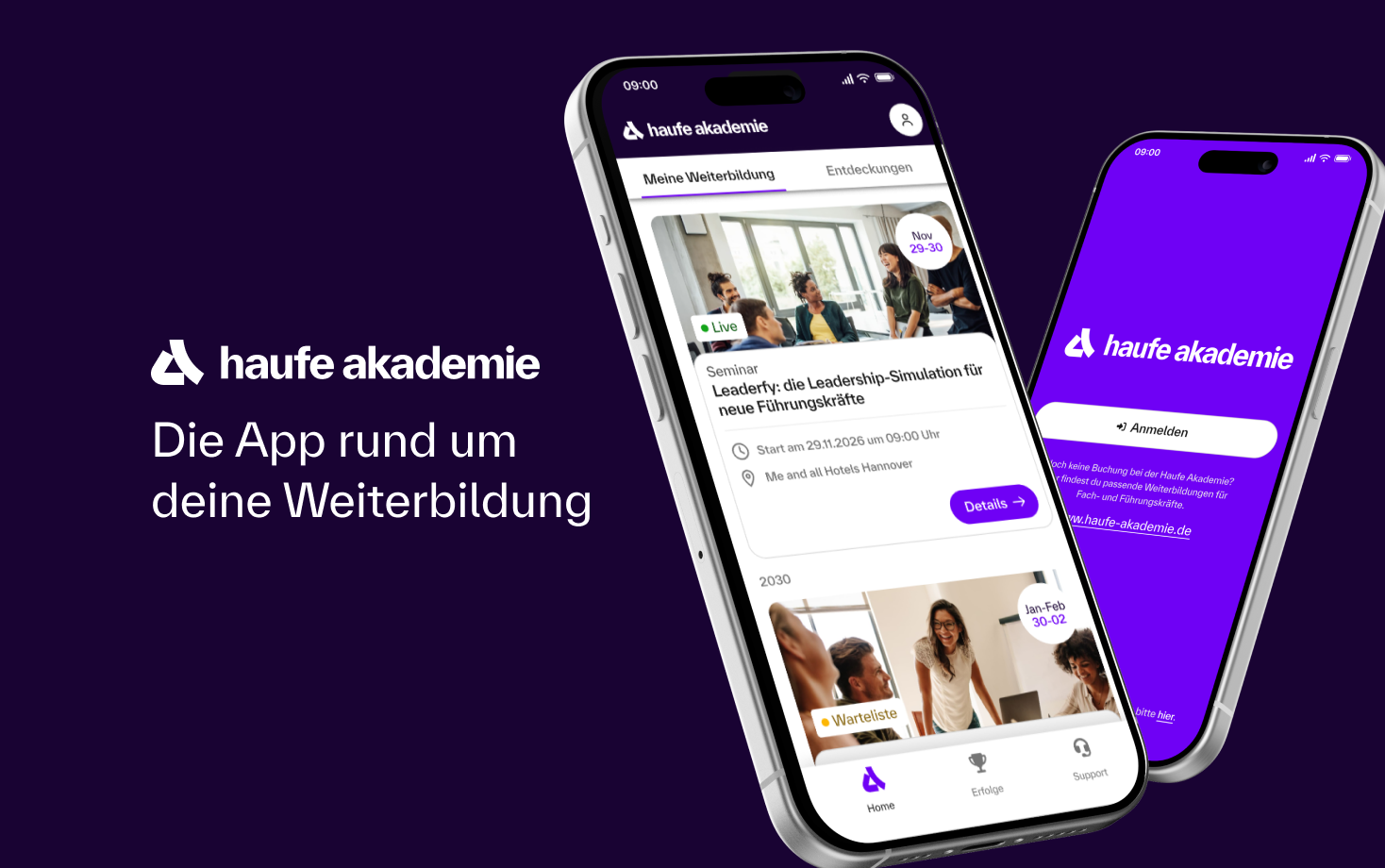
- Training app
- Business Solutions


