Leadership Development During Transformation

An automotive supplier is facing reorganization, job cuts, and a fundamental shift in its business model. This client project demonstrates how 45 executives became active architects of the transformation through a ten-month learning journey.

Initial Situation

Leadership in transition

An automotive supplier is facing a reorganization, job cuts, and a fundamental transformation of its business model. Approximately 45 mid-level managers are expected to provide direction, make decisions, and take cross-functional action.

3.800

Employees at the main plant

45

middle managers

5

Key barriers to transformation

The challenge

What Hinders Leadership in Everyday Life

When Transformation Becomes a Leadership Issue: An automotive supplier is facing a profound transformation. A large portion of its existing business is losing significance due to the rise of electric vehicles. At the same time, reorganization and job cuts are underway. Top performers are leaving the company, and the workforce is feeling uncertain.

Not enough guidance

Decisions are delegated upward. Under pressure, managers revert to their former role as “ subject matter experts s.”

Lack of clarity in communication

When difficult news arises, restraint and silence prevail. Rumors begin to spread, and employees lose their bearings.

Not enough shared responsibility

Long-standing departmental boundaries hinder collaboration and, as a result, important transformation initiatives.

The Solution

A Learning Journey Based on Specific Needs

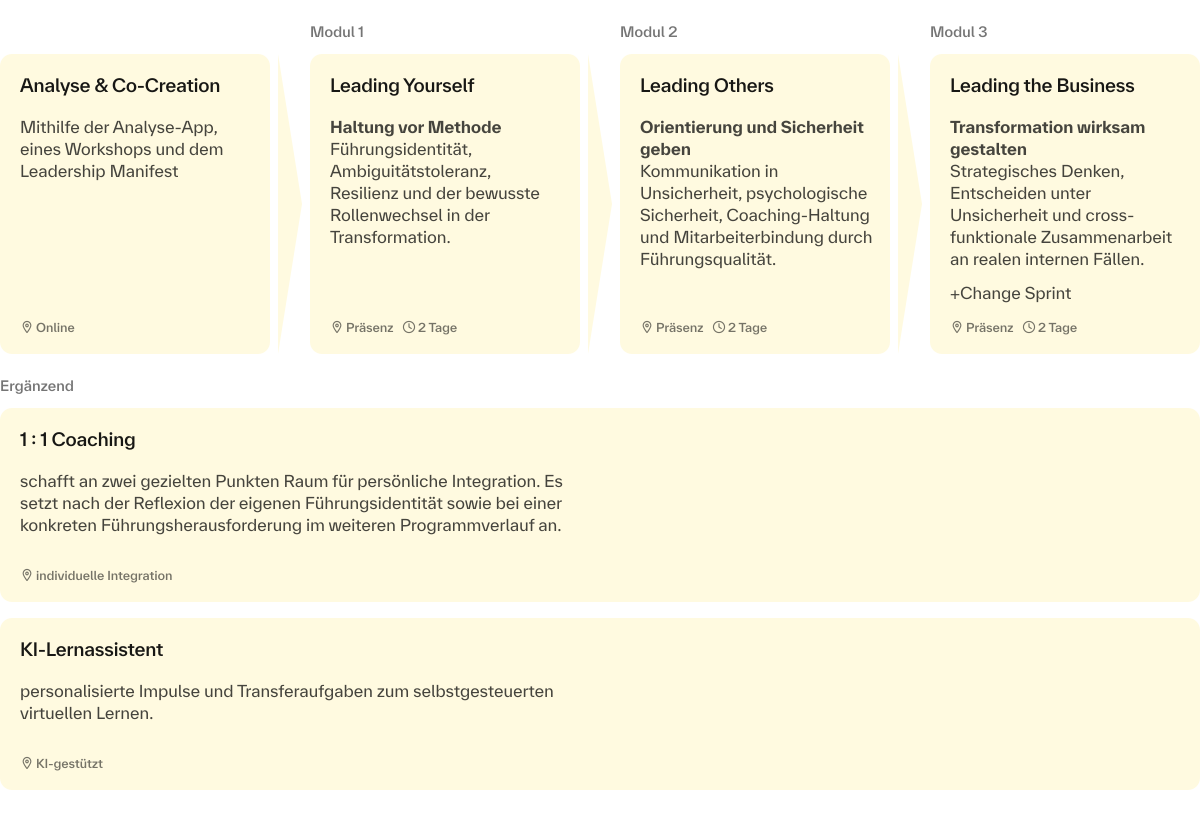
Instead of another one-on-one training session, a ten-month learning journey was developed. The starting point was a structured analysis of the leadership situation. Through a co-creation process, this led to the development of a shared leadership manifesto to serve as a guide for the subsequent modules.

The Change

Three moments when new leadership became apparent

The Effect

Making Changes in Leadership Measurable

≥ 20%

Leadership Behavior: Improvements in Communication, Decision-Making, and Empowerment in 360° Feedback

-25%

Turnover Among High Performers Compared to the Same Period Last Year

3 out of 5

Transformation initiatives
with measurable progress driven by improved leadership

≥ 90%

Program Completion as an Indicator of Acceptance and Commitment

Are your managers facing a similar challenge?

Together, we’ll assess your current situation, identify the relevant target audiences, and pinpoint the development levers with the greatest impact. Book a personal consultation or contact us at e-mail using our contact form.

Online consultation appointment

Personal consultation

Do you have questions about our leadership development programs? We’d be happy to address your concerns in a personal, no-obligation conversation. Simply select a convenient time—the conversation will take place online via MS Teams.


Celine Oechler

and her team will be happy to advise you.

FAQ

Frequently asked questions

How does leadership development support corporate transformation?

Transformation not only changes structures and processes, but also places new demands on leadership. Leaders must provide direction, make decisions amid uncertainty, communicate changes clearly, and actively involve and engage employees. Targeted leadership development creates a shared framework for guidance and translates the demands of transformation into concrete leadership actions.

‍

What skills do managers need during reorganization and layoffs?

Reorganizations present managers with unique challenges: gaining clarity about their own roles and scope of action, communicating transparently—even when not all answers are clear yet—and providing guidance to their teams despite uncertainty. Added to this are the ability to make decisions, self-reflection, and the ability to foster collaboration across existing departmental boundaries.

The Be6! Leadership Framework links these requirements to specific competencies and areas of action, thereby offering leaders a practical development framework tailored to their individual situations.

How can the impact of a leadership development program be measured?

Ideally, impact measurement begins even before the program starts. Development goals, baseline values, and appropriate metrics are defined collaboratively. Depending on the objectives, changes can be assessed at both the organizational and individual levels—for example, changes in leadership behavior, employee engagement, turnover, the transfer of learning into daily work, or the progress of strategic initiatives.

The goal should not only be to measure whether participants were satisfied with a program, but also to assess what changes subsequently occurred in their day-to-day leadership practices. Analysis, implementation, and evaluation are therefore integral components of a systematic leadership development program.

What role do coaching and AI-powered learning support play?

Coaching and AI-powered learning support can effectively complement Development Programs . In one-on-one coaching, individual leadership issues can be addressed in a depth that is not possible in a group setting. AI-powered learning support can also provide personalized prompts and application exercises, thereby supporting learning between group sessions.

Neither format replaces the development program. Their strength lies in combining collaborative learning with individual development and continuous application of what is learned in practice. Depending on needs, such supplementary formats can be integrated into leadership development programs.