CSRD and the EU Taxonomy: An Overview of Obligations, Thresholds, and Interrelationships


Sustainable business practices are becoming increasingly important and are presenting companies with new challenges when it comes to reporting. Two terms that play a central role in this context are the Corporate Sustainability Reporting Directive (CSRD) and the EU Taxonomy. What do these terms mean, and how are they related?
CSRD and the EU Taxonomy: Key Points at a Glance
- The CSRD generally applies to companies with more than 1,000 employees and net revenue exceeding 450 million euros.
- The Omnibus I Directive (EU) 2026/470 has been in effect since March 18, 2026. Member States will implement the CSRD amendments by March 19, 2027.
- On July 3, 2026, the Commission adopted a revised, significantly shortened version of the ESRS.
- Companies report the taxonomy-eligible and taxonomy-compliant portions of revenue, CapEx, and OpEx. Starting in 2026, a materiality threshold of 10 percent and simplified reporting tables will apply.
- The CSRD Implementation Act is currently going through the legislative process. Until then, the existing law remains in effect.
CSRD: A new standard for sustainability reports
The Corporate Sustainability Reporting Directive requires large companies to include a standardized, externally audited sustainability report in their management report. Under the Omnibus I reform, it generally applies to companies with more than 1,000 employees and more than 450 million euros in net revenue.
The European Commission concluded that nonfinancial disclosures in corporate reporting need to be improved. A key objective of reporting is to provide the relevant stakeholders with a sufficient information base for potential decisions in the capital market. This requires a certain degree of comparability and reliability in nonfinancial reporting.
To ensure consistent reporting, the EU has established a key element: On January 5, 2023, the Corporate Sustainability Reporting Directive (CSRD) entered into force. It is a crucial part of the European strategy to create a sustainable economic and financial system and primarily addresses disclosure requirements in the area of sustainability. The adoption of the CSRD heralded a major shift in corporate reporting. Whereas the focus had previously been primarily on presenting financial performance, the reporting of non-financial factors now takes on a new (mandatory) position .
As a result, the directive significantly exceeds previous requirements for sustainability reporting in terms of complexity and scope. In addition, other companies were to be gradually required to report, in addition to the capital market-oriented companies with more than 500 employees that were previously subject to reporting requirements. The omnibus reform has significantly narrowed this group and postponed the phased implementation.
Omnibus I: Law in effect as of March 18, 2026
Omnibus I is no longer a proposal but is now EU law: The Council finally adopted Amending Directive (EU) 2026/470 on February 24, 2026. It entered into force on March 18, 2026. Member States must implement the CSRD amendments by March 19, 2027.
In February 2025, the European Commission presented a series of proposals—known as the “Omnibus Initiative” —aimed at simplifying sustainability reporting and reducing the associated burden. The initiative focused on three objectives:
- remove bureaucratic hurdles
- Providing Businesses with Planning Certainty
- Promoting Sustainable Investment
Key CSRD requirements have also been simplified as a result—for example, through extended deadlines and adjusted thresholds. Companies should therefore definitely reassess their existing reporting strategies in light of the new framework, but under no circumstances should they let up in their efforts.
Which companies are subject to CSRD reporting requirements, and when?
Starting in 2024 (reporting in the 2025 annual report), companies that are already subject to the Non-Financial Reporting Directive (NFRD) will be affected. These include capital market-oriented companies with more than 500 employees, as well as banks, insurance companies, and fund management companies—so-called large public-interest entities. The first wave of CSRD reporting requirements begins with the 2024 fiscal year (2025 report). It applies to companies that are already subject to the Non-Financial Reporting Directive (NFRD). If companies in this first wave no longer meet the new thresholds, member states may exempt them from the reporting requirements for the 2025 and 2026 fiscal years.
Omnibus I Update
With the Omnibus I Directive, the Parliament and the Council have adjusted the thresholds and timelines for reporting requirements. In the future, only companies with more than 1,000 employees and net revenue exceeding 450 million euros will be subject to the CSRD. The thresholds of 25 million euros in total assets or 50 million euros in revenue were included in the Commission’s proposal from February 2025 and did not become law. Capital market-oriented SMEs are completely exempt from reporting requirements.
The "Stop the Clock" Directive (EU) 2025/794 has already postponed the start of the second and third waves by two years, to 2025. The Omnibus I Directive has been in effect since March 2026; the provision regarding final adoption no longer applies. The start dates are as follows:
- Fiscal Year 2024 (2025 Report): The first wave has already submitted its reports—that is, large companies that were previously subject to the NFRD.
- Fiscal Year 2027 (2028 Report): All other companies above the new thresholds will report for the first time. Starting with this fiscal year, the new classification will apply uniformly.
- Fiscal Year 2028 (2029 Report): Companies from third countries must file a report if they generate more than 450 million euros in net revenue in the EU and their EU subsidiary or branch generates more than 200 million euros in net revenue.
SMEs and the VSME Standard
Capital market-oriented small and medium-sized enterprises (SMEs), which were originally required to begin reporting in 2026, are fully exempt from reporting requirements under the Omnibus I Directive. The EU justifies this move with the goal of not placing an undue burden on SMEs and preserving their competitiveness. While this provides relief for many SMEs, indirect pressure may still arise—for example, from larger business partners, banks, or investors who request sustainability information.
For these cases, the European Commission adopted a voluntary reporting standard on July 3, 2026, for companies outside the scope of the CSRD: the VSME Standard (Voluntary Reporting Standard for SMEs). It builds on the 2024 EFRAG standard, which the Commission had recommended in 2025.
SMEs that are not subject to reporting requirements can thus respond to inquiries from banks and large companies in a consistent and proportionate manner. The standard also establishes the “value chain cap”: Companies subject to reporting requirements may not request information from business partners with up to 1,000 employees that goes beyond the scope of the voluntary standard. The regulation will take effect as soon as the review period by the European Parliament and the Council expires.
Status of Implementation in Germany
- EU Law: The Omnibus I Directive has been in effect since March 18, 2026, but its impact on companies is felt only through national laws. The deadline for implementing the CSRD amendments is March 19, 2027.
- Legislation: The CSRD Implementation Act is currently before the Bundestag as a government bill dated September 3, 2025. The CDU/CSU and SPD submitted an amendment at the end of March 2026 that incorporates the omnibus reform. The Committee on Legal Affairs heard testimony from experts on April 13, 2026.
- Status: As of September 2026, the proceedings have not yet been concluded.
- Applicable Law: Until this law takes effect, the existing legal framework under the 2017 CSR Directive Implementation Act shall remain in force.
- ESRS: The European Sustainability Reporting Standards (ESRS) are a delegated regulation and do not require national implementation. The Implementation Act specifies which entities in Germany are required to report in accordance with these standards.
This is what lies behind the EU taxonomy
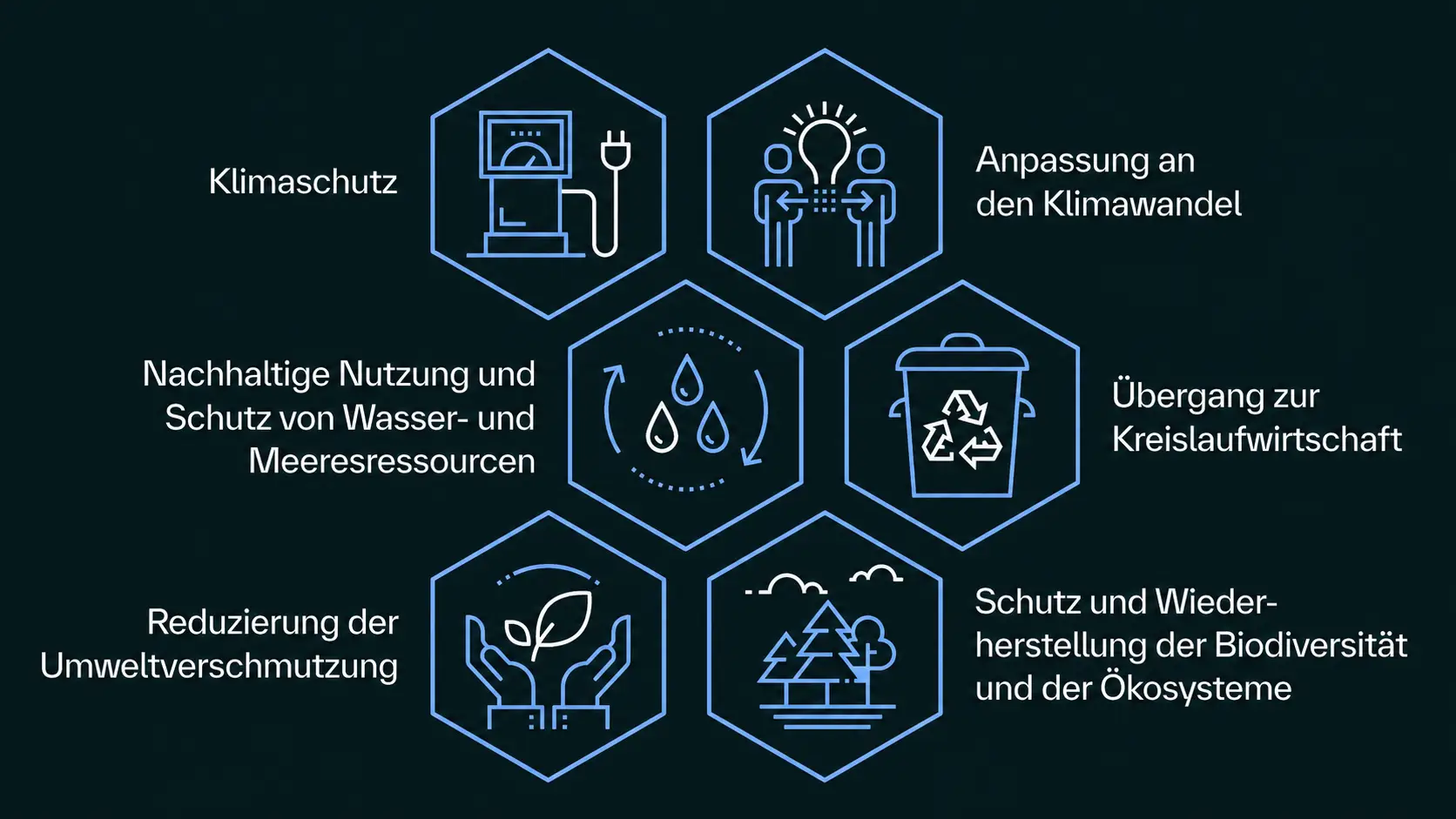
The EU Taxonomy is a key component of the European Green Deal and serves to classify sustainable economic activities. Its goal is to promote investment in environmentally friendly innovations and support the green transition in the EU. It helps achieve climate neutrality by 2050 and reduce greenhouse gas emissions by 2030. An economic activity is considered environmentally sustainable—and thus taxonomy-compliant—only if it meets all four requirements simultaneously.
- It makes a significant contribution to at least one of the six environmental goals.
- It does not significantly harm any of the other environmental goals ("Do No Significant Harm," DNSH).
- It complies with minimum protection requirements, that is, minimum social standards.
- It meets the technical evaluation criteria established by the Commission in delegated acts.
The following chart shows the six environmental goals:
Key Metrics of the Taxonomy
The reporting requirement under the EU Taxonomy applies to companies subject to the CSRD. It is based on Article 8 of the Taxonomy Regulation, and companies must disclose this information in their sustainability reports. Both taxonomy-eligible and taxonomy-compliant portions must be reported:
The Commission has simplified the taxonomy’s reporting requirements through Delegated Regulation (EU) 2026/73. It was published in the Official Journal on January 8, 2026, and entered into force on January 28, 2026. The changes apply as of January 1, 2026, for the 2025 fiscal year. Companies may also choose to apply them only starting with the 2026 fiscal year.
- Materiality threshold: Companies are not required to conduct a detailed assessment of taxonomy readiness and compliance for activities that account for less than 10 percent of revenue, CapEx, or OpEx. The threshold applies to each metric individually.
- Reporting Templates: The Commission has revised and simplified the templates for all reporting companies.
- Chemical criterion: There is no requirement to test self-classified substances in accordance with the CLP Regulation.
- Further Review: The Commission is also reviewing the technical evaluation criteria and sought feedback on this matter in March 2026.
Link between the CSRD and the EU Taxonomy
While the CSRD requires companies to report comprehensively on environmental, social, and governance issues, the EU Taxonomy, on the other hand, is a classification system that establishes clear criteria for determining which economic activities are considered environmentally sustainable. It serves as a framework for investors, companies, and policymakers to identify and promote sustainable investments.
The link between the CSRD and the EU Taxonomy lies in reporting: Companies subject to the CSRD must also disclose in their reports the extent to which their activities align with the EU Taxonomy. This means they must provide detailed information on how their economic activities contribute to the EU’s environmental goals. This link ensures that companies’ sustainability reports are not only comprehensive but also comparable and standardized, which in turn minimizes the risk of greenwashing. Legally, the two sets of regulations remain separate: The taxonomy disclosures are based on Article 8 of the Taxonomy Regulation (EU) 2020/852 and Delegated Regulation (EU) 2021/2178. They are not simply part of the ESRS but constitute a separate reporting requirement within the sustainability report.
A Comparison of the Three Sets of Rules


What are companies required to report under the CSRD Directive?
The binding European Sustainability Reporting Standards (ESRS) specify the mandatory content that a company must include in its sustainability report going forward. These standards cover all ESG areas. Through their comprehensive and technical reporting requirements, the ESRS ensure consistent and comparable reporting.
EFRAG (formerly the European Financial Reporting Advisory Group) develops technical drafts and recommendations on this matter. The ESRS become legally binding only upon adoption by the European Commission through Delegated Regulation (EU) 2023/2772. The current set includes two cross-cutting standards—ESRS 1 and ESRS 2—as well as 10 topic-specific standards. ESRS 1 sets out general requirements for the preparation and presentation of sustainability reports and stipulates that the individual topic-specific standards must undergo a dual materiality analysis. ESRS 2 specifies general disclosures that must be reported by all companies, regardless of their materiality analysis.
On July 3, 2026, the European Commission adopted revised, significantly streamlined ESRS. They reduce the number of mandatory data points by more than 60 percent and the total number of data points by more than 70 percent. The Commission expects cost reductions of more than 30 percent per company. The legislative act is currently before the European Parliament and the Council for review and will take effect once this period expires. The revised ESRS will be mandatory for reporting periods beginning on or after January 1, 2027. For earlier periods beginning on or after January 1, 2026, companies may apply them in advance through transitional options.
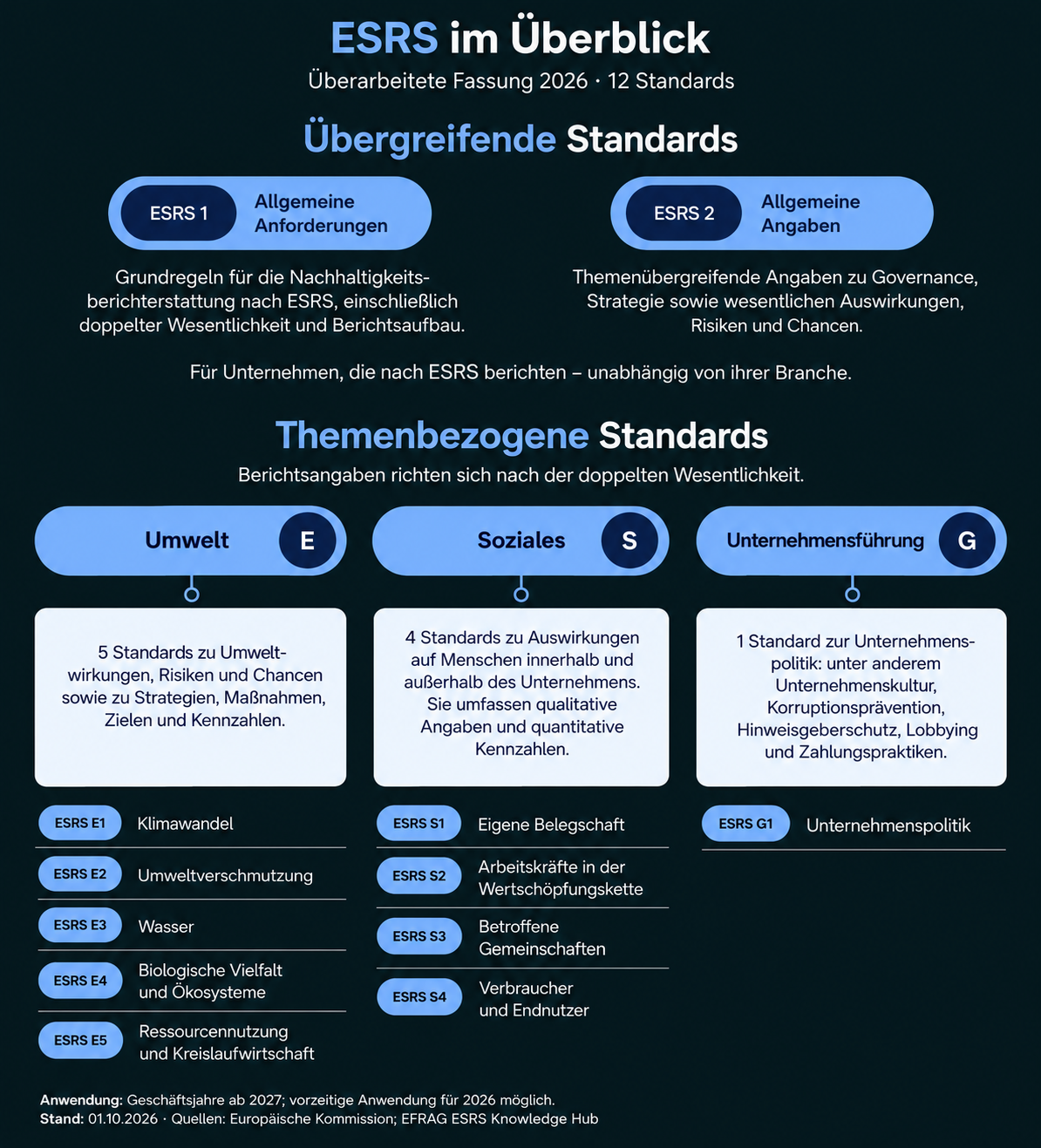
An Overview of the Current ESRS Rate
External audit is mandatory
Companies subject to the CSRD (see above) must have their sustainability report reviewed by an independent external auditor. The external review of the sustainability report remains mandatory under the Omnibus Initiative as well, though without an increase in the level of review. A review providing only limited assurance is sufficient. The originally planned expansion to a “reasonable assurance” audit has been dropped. Instead, the EU intends to develop targeted audit recommendations in the form of so-called “targeted assurance guidelines.” The goal is to limit the burden on companies while maintaining the reliability of reporting. This also places new demands on audit firms, which will be entrusted with these additional responsibilities. The external audit is an EU requirement. The CSRD Implementation Act governs who is authorized to conduct audits in Germany: The government’s draft bill specifies that auditors must be certified public accountants and does not exercise the option to authorize other audit service providers.
Training: the key to successful implementation
It is crucial for the successful implementation of the CSRD Directive that employees in all relevant positions are trained. This applies in particular to employees in the areas of finance, controlling and sustainability reporting. Training should cover the basics of CSRD, the reporting requirements and the link to the EU taxonomy. The regulations are constantly subject to extensive adjustments and updates. It is therefore essential to stay on the ball and build up and continuously expand your own company's expertise.
In addition to the departments mentioned—such as Controlling, which must provide specific figures for the sustainability report—it is important to make the topic of sustainability and related knowledge accessible throughout the entire company. Employees in purchasing or the mailroom who are familiar with sustainability issues can identify areas for improvement even before anyone asks for the key metrics. With the help of the Compliance College, you can make this very knowledge available to all employees and thus unlock untapped potential.
Outlook: The future of sustainability reporting
The CSRD and the EU Taxonomy are important steps toward a more sustainable economy. They offer companies the opportunity to make their sustainability performance transparent and to position themselves as responsible stakeholders. For stakeholders , they create a solid foundation for well-informed decisions regarding sustainability and long-term corporate success. As a result, sustainability is evolving from a peripheral issue into a central aspect of corporate governance and communication. There are now plenty of concrete examples to follow: Deloitte and the DRSC have analyzed sustainability reports from publicly traded companies listed on the DAX, MDAX, and SDAX that were published by April 30, 2026. Companies can use these reports as a guide and adapt them to their own requirements.
Summary: The CSRD introduces important changes
- Dual materiality: Companies must report both on the impacts of their business activities on people and the environment and on the impacts of sustainability issues on the company.
- External Audit: Sustainability reporting must be subject to an external audit providing limited assurance.
- Inclusion in the Management Report: Sustainability information will become a mandatory part of the management report, underscoring its importance.
- Standardized Electronic Reporting Format: Reports must be disclosed in the European Single Electronic Format (ESEF), which is readable by both humans and machines. The requirement for digital tagging has been postponed until detailed regulations are in place.
FAQ
Who will be subject to the CSRD in 2026 and 2027?
Generally, companies with more than 1,000 employees and more than 450 million euros in net revenue. The first wave has been reporting since the 2024 fiscal year. All other companies above the thresholds will follow starting in the 2027 fiscal year. Member States may exempt companies in the first wave that fall below the new thresholds for the years 2025 and 2026.
What is the difference between “taxonomy-ready” and “taxonomy-compliant”?
An economic activity is “eligible” for the taxonomy if it is described in the delegated acts of the taxonomy. It is considered “aligned” with the taxonomy only if it also makes a significant contribution to an environmental objective, does not significantly harm any other environmental objective, complies with the minimum protection requirements, and meets the technical assessment criteria. Thus, eligibility indicates that an activity is, in principle, covered by the taxonomy. Alignment indicates that it also meets the criteria.
What changes were made to the EU taxonomy in 2026?
Delegated Regulation (EU) 2026/73 introduces a materiality threshold of 10 percent for revenue, CapEx, and OpEx and simplifies the reporting tables. It takes effect on January 1, 2026, for the 2025 fiscal year. Companies may also choose to apply it only starting with the 2026 fiscal year.
You might also be interested in