Personalized Learning: How Companies Can Make Professional Development Truly Effective


Training budgets are being spent, learning platforms are filling up, and yet skills gaps remain unclosed. Personalized learning turns this logic on its head: instead of putting all employees through the same program, this type of training is tailored to the individual skills, roles, and learning goals of each person. What sounds like a luxury can now be implemented even in large organizations with the right system and a clear learning architecture. This article explains what personalized learning means in a corporate context, what strategic value it offers, and how L&D leaders can successfully get started.
Personalized Learning: The Key Points
- Personalized learning tailors professional development to individual skills, roles, and learning objectives.
- The strategic benefits: Skills gaps are addressed more effectively, motivation to learn increases, and training budgets are used more efficiently.
- The foundation is based on competency profiles and skill mapping.
- Learning paths combine required content, elective modules, and microlearning components tailored to specific roles and tasks.
- LMS LXP the technical infrastructure for structured management, personalized learning experiences, and self-directed learning.
- Artificial intelligence and learning analytics make personalization scalable and success measurable.
- AI-powered learning formats also personalize the learning experience within each individual nugget, regardless of the platform or learning path.
What is personalized learning?
This is what personalized learning means: training is not based on the lowest common denominator, but on the individual. It is grounded in individual skills, roles, learning objectives, and specific needs in the day-to-day workplace.
L&D managers design learning programs based on competency profiles, skill gaps, and career goals. Employees receive content that is relevant to them at the right time and in the right format.
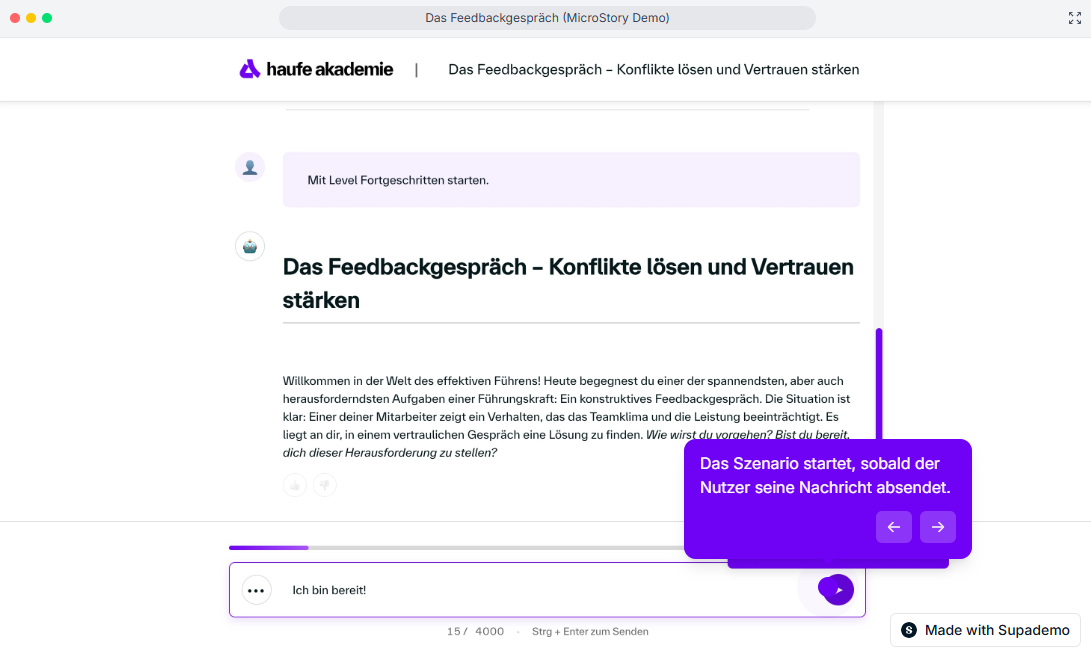
AI enables a deeper level of personalization: it not only tailors the content a person receives, but also how the learning process unfolds within a single format. Anyone who starts an AI-powered microlearning module experiences a dialogue that responds to their own inputs, decisions, and individual level of knowledge.
This makes AI-powered learning formats a standalone personalization tool that operates independently of skill mapping or learning path architecture.


Why personalized learning is strategically important for businesses
Skills shortages, technological change, and the increasingly short shelf life of knowledge are putting pressure on companies. Companies that want to develop their employees over the long term need more than just standard training programs. These programs lay the foundation for personalized learning, but they are no longer sufficient on their own.
Close skill gaps before they become a problem
In many organizations, the gap between existing and required skills is growing faster than traditional training cycles can bridge it. Personalized learning addresses individual skill gaps directly. Employees do not all follow the same program; instead, they receive exactly the support they need. This makes upskilling and reskilling more effective, targeted, and predictable.
Motivation to learn increases when the content is relevant
Learning is most effective when employees see how it relates to their own work. When people receive content that aligns with their role, skill level, and goals, they learn more actively and retain what they’ve learned for longer. Greater motivation to learn directly translates into better learning outcomes and more effective application of that knowledge in practice.
Strengthening employee retention and employability
Personalized professional development sends a clear message: the company is investing in the development of each individual. This has a positive impact on employee retention, satisfaction, and the company’s appeal as an employer. At the same time, it enhances employees’ employability—a win-win situation that should not be underestimated strategically in an era of securing skilled workers.
The Benefits of Personalized Learning in Human Resources Development
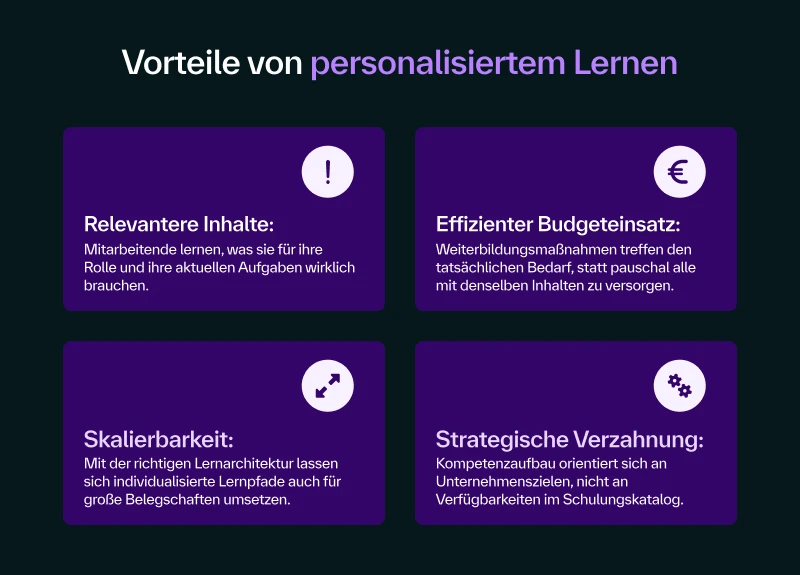
Personalized learning benefits both companies and employees alike. The key benefits at a glance:
- More relevant content: Employees learn what they really need for their roles and current tasks.
- Efficient use of funds: Training programs are tailored to actual needs rather than providing the same content to everyone across the board.
- Scalability: With the right learning architecture, personalized learning paths can be implemented even for large workforces.
- Strategic alignment: Skills development is guided by corporate goals, not by what’s available in the training catalog.
How personalized learning works in practice
Personalized learning requires a solid foundation: Without knowing which skills are already present in the company and which are lacking, it is impossible to develop meaningful learning paths.
Competency profiles and skill mapping as a starting point
The first step is transparency. Companies systematically identify the skills their employees possess and align them with the requirements of specific roles and the company’s strategy. This results in clear competency profiles that serve as the foundation for all subsequent initiatives. Role models help structure expectations and deliver targeted learning recommendations.
Combining learning paths, elective modules, and microlearning in a meaningful way
Personalized learning paths combine required content with individual options. Employees no longer follow a rigid course schedule, but rather a program tailored to their skill level and goals. Typical components:
- Mandatory training for regulatory or company-wide content
- Elective modules based on role, career goals, or identified skill gaps
- Microlearning for short, context-specific learning opportunities directly in the workplace
- AI-powered learning formats for learning experiences that adapt to the learner’s inputs, knowledge level, and decisions within a single nugget
Managers and Self-Management
The personalized learning approach only works when the right conditions are in place. Leaders play a central role: they identify development needs within the team, provide learning opportunities, and create space for Learners. At the same time, employees need to be willing to take responsibility for their own development. Self-directed learning does not happen on its own. L&D must actively foster the skills needed for it.
What technologies enable personalized learning?
Personalized learning requires the right technical foundation. Two types of platforms play a role in this:
- Learning Management System: A LMS is the foundation for organizing and managing formal continuing education: managing courses, documenting learning progress, and fulfilling legal obligations. It provides the necessary structure for successful learning.
- Learning Experience Platform: A LXP focuses on the individual’s learning experience: personalized learning recommendations based on interests and usage behavior, self-directed learning, informal exchange, and user-generated content.
AI and Learning Analytics as Enablers
AI-poweredrecommendation systems analyze competency profiles, learning behaviors, and skill gaps, and suggest relevant content at the right time. Learning analytics reveals what really works: Which content is being used? Where do employees drop off? Where are they making progress in their skills?
In addition, AI enables a content-based level of personalization: within a single learning format, it responds to the Learners , thereby creating a unique learning experience.
It is important to note that training data is sensitive. Clear governance and the early involvement of the works council are essential for ensuring acceptance and legal certainty.
Implement personalized learning
Here's how to do it:
- Analyze the current situation: What skills are available, and which ones are missing? Without a thorough skills gap analysis, any personalization is just a guess.
- Segmenting target groups: Not all employees have the same needs. Roles, experience levels, and career goals determine which learning paths are appropriate.
- Building a learning architecture: defining required content, structuring elective modules, integrating microlearning, and aligning everything with real-world tasks in the workplace.
- Start small: A pilot program is better than a large-scale rollout. What works can be scaled up. What doesn't work can be corrected early on.
- Iterative improvement: Usage data, feedback, and progress in skills highlight areas that need adjustment. Personalized learning is an ongoing process.
Best Practices for Personalized Professional Development
What works in practice? These principles have proven effective:
- Roles, skills, and career goals as a starting point: Learning pathways are effective when they are grounded in specific work situations, not in generic lists of competencies.
- Combining requirements with personalization: Not everything can be customized. Required content remains where it is necessary. What matters is that the rest is tailored to the individual.
- Use targeted learning prompts: Small, context-specific reminders and recommendations help maintain motivation to learn without overwhelming employees.
- Less is more: Too many learning options can be overwhelming. A curated selection that truly fits the role is better than an overloaded course catalog.
- Highlighting achievements: Progress in skills, completed learning paths, and practical examples of how knowledge is applied motivate employees and build internal support for L&D.
Measuring Success: Which KPIs Really Matter
Personalized learning only delivers value if companies can measure its impact. Key metrics include:
- Usage Data and Completion Rates: Are offers being accepted? Where do employees drop off?
- Skill Development: Are the identified skill gaps actually being closed?
- Putting theory into practice: Do employees apply what they’ve learned in their day-to-day work? How does this affect performance and project outcomes?
- Business Impact: Is the internal staffing rate for critical roles changing? Does productivity increase in teams with more training?
- Qualitative feedback: Numbers alone aren't enough. Regular feedback loops reveal whether content is perceived as relevant.
Personalized learning as a driver of modern human resources development
Personalized learning is not just a trend, but a strategic necessity. Companies that consistently align their professional development programs with individual skill profiles, roles, and learning objectives develop their employees more effectively and close skill gaps before they become a real problem.
The best way to get started is to proceed step by step, beginning with a thorough needs assessment, a well-thought-out learning framework, and the right technical foundation.
The Haufe Akademie L&D professionals in two ways:
- Content Kit: Over 2,000 professionally produced microlearning modules that can be flexibly combined into personalized learning paths—ready to use, scalable, and tailored to different roles and experience levels. AI-powered formats such as MicroStory and MicroTool personalize the learning experience within a single nugget. The AI uses relevant personal learning data to do so.
- Learning Experience Platform LXP): The technological foundation for personalized learning in the workplace. AI-powered recommendations, skill transparency, and seamless integration with existing HR systems turn self-directed learning from a promise on paper into a reality.
FAQ
For companies of what size is personalized learning worthwhile?
In principle, it’s for everyone, but the approach varies. Large companies benefit primarily from scalability: with the right program, personalization can be implemented even for thousands of employees. Smaller companies often take a more pragmatic approach: with role-specific learning paths, curated content, and clear competency profiles. What matters is not the size of the company, but the willingness to consistently align training with actual needs.
What does an L&D department need to develop personalized learning programs?
Three things are essential:
- a clear competency model that defines which skills are relevant for which roles
- a database—that is, reliable information about what employees are already capable of and where there are gaps
- the organizational willingness to shift from standardized programs to needs-based learning architectures
How can personalized learning be integrated into existing L&D processes?
The best approach is a phased rollout. Existing mandatory programs remain in place where they make sense. In addition, elective modules and personalized learning paths can be developed based on competency profiles. It is important to integrate personalized learning with existing HR processes. This creates a cohesive learning environment.
You might also be interested in