Learning with AI: How AI-powered learning is transforming corporate training


Structured knowledge transfer remains a key foundation of corporate training. To complement this, knowledge must be applied in practice. Knowledge that is taught in isolation from everyday work rarely sticks. AI-powered learning addresses this very issue: Artificial intelligence connects learning content to the specific work context, tailors content to individual needs, and turns learning into a genuine dialogue. This article highlights the concrete opportunities available to L&D professionals today and explains how they can strategically approach the transition to AI-powered learning.
Learning with AI: The Key Points at a Glance
- Traditional training formats rarely fail because of their content, but rather because of the lack of application in everyday work.
- AI-powered learning tailors the pace, difficulty level, and content to each individual, turning a course into a genuine dialogue.
- New formats such as MicroStory and MicroTool combine learning and work into a single process: employees practice directly on their own tasks.
- Immediate feedback, active participation, and a strong connection to real-world work make AI-supported learning pedagogically superior.
- The process consists of four steps: needs analysis, system integration, make-or-buy decision, and performance measurement.
- Data protection, algorithmic transparency, and the EU AI Regulation should be taken into account from the very beginning.
How does artificial intelligence work in learning?
AI-powered learning is based on algorithms that continuously analyze what Learners , how they respond to content, and where gaps exist. Based on this analysis, they adapt learning content and pathways in real time. For L&D professionals, it is helpful to distinguish between three areas of technology:
- Adaptive algorithms analyze each learner’s individual level of knowledge and determine which learning content is most appropriate next. Learners who have already mastered a topic move forward more quickly. Those with gaps in their knowledge receive in-depth lessons tailored precisely to their current learning process.
- Generative AI—specifically large language models (LLMs)—enables genuine dialogue between learners and an AI-powered tool. Instead of passively consuming learning content, employees ask questions and receive personalized answers.
- Natural Language Processing (NLP) is the ability of artificial intelligence to understand and process natural language input. It provides the foundation for personalized real-time feedback.
Important to note: AI does not make learning decisions. It helps Learners reach their goals more quickly and effectively, while also reducing the workload for L&D teams in supporting individual learning processes.


AI-Supported Learning in Practice: Specific Areas of Application
The greatest potential of AI-powered learning lies where traditional formats fall short: in applying what’s learned to everyday work. Two AI-powered microlearning formats from the Haufe Akademie Content Kit Haufe Akademie how this works in practice.
MicroStory: AI-powered learning through realistic scenarios
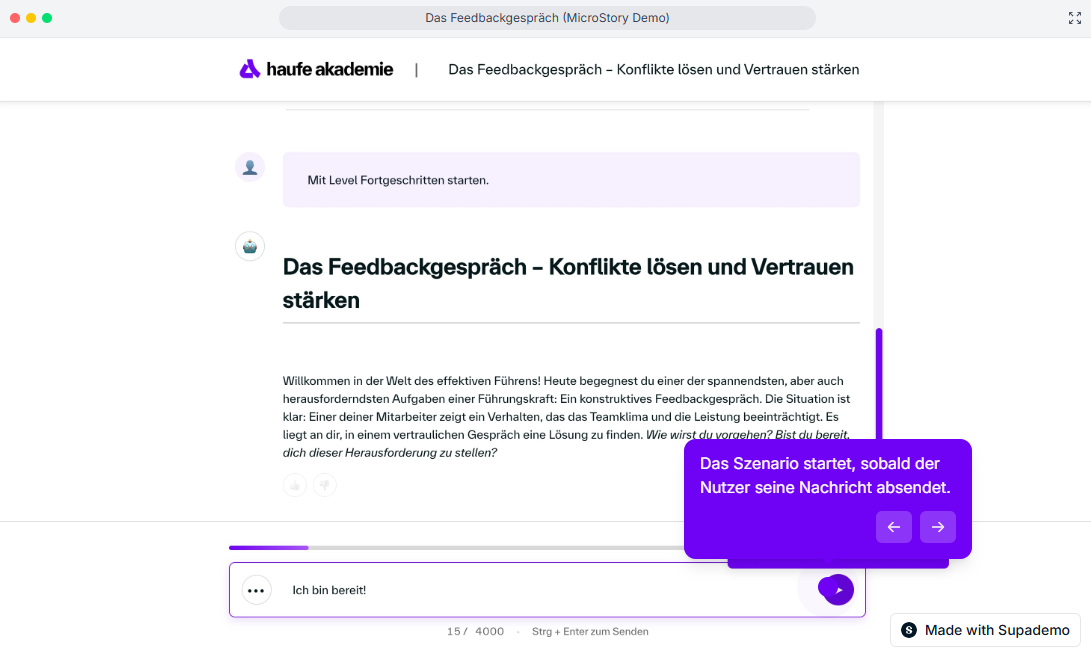
With MicroStory, Learners immerse themselves Learners an AI-driven scenario modeled after real-world work situations. Unlike traditional simulations with predetermined decision paths, the AI tool responds adaptively to every input. Learners their own decisions and immediately see the consequences of those decisions.
A typical scenario: a difficult feedback conversation with a direct report. The AI takes on the role of the conversation partner and adapts the dialogue to each response. The feedback isn’t given at the end of the course, but immediately during the conversation—specific and tailored to the task at hand.
MicroTool: AI-powered support for specific work tasks
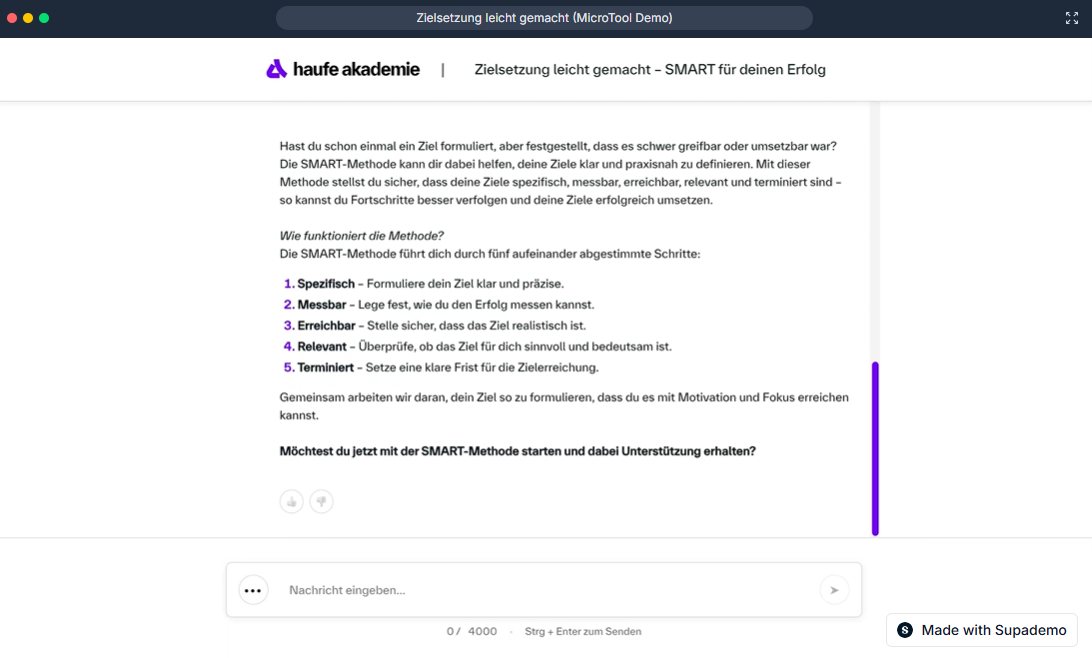
With MicroTool, employees apply a method directly to a current task they are working on in their daily work. The AI tool guides them step by step, provides explanations tailored to their needs, and adapts to their individual situation. Learning and working happen as a single, integrated process.
Here’s a concrete example: setting SMART goals (specific, measurable, achievable, realistic, time-bound). Instead of taking a purely informational course, the individual works directly on a real goal within their area of responsibility—with AI serving as a personal learning coach and providing support every step of the way.
Other Applications of AI in Continuing Education
MicroStory and MicroTool are two specific formats, but AI in professional development opens up further relevant areas of application in a corporate context:
- Skill Mapping and skills assessment: AI tools analyze existing skills and identify gaps within the team. Building on this, targeted learning paths can be developed that are closely integrated with a Learning Experience Platform LXP). This supports strategic talent development based on real skills data.
- AI-powered content creation: L&D teams use generative AI to produce learning materials more quickly, update courses, and tailor content to different audiences without having to start from scratch every time. It’s important to note that the focus shifts from content creation to quality assurance. AI-generated content must be carefully reviewed before it is deployed.
- Conversational Learning: AI chatbots are available to employees as learning guides on their learning platform, answering technical questions and recommending relevant content when needed. Support is available around the clock, regardless of time or location. Here, too, the quality of the answers depends on the underlying content and should be reviewed regularly.
What Makes AI-Supported Learning Different from a Pedagogical Perspective
AI-powered learning is based on pedagogical principles that have been considered well-established for decades, and implements them more consistently than many traditional formats.
Situated learning holds that knowledge is retained more effectively when it is acquired in the context in which it will actually be used. This is exactly what MicroStory and MicroTool achieve. Learners do not practice using abstract examples that have little to do with their daily tasks, but rather directly within their own work environment.
Added to this is the impact of immediate, personalized feedback. In a traditional course, Learners only find out Learners the end what was right or wrong. AI-based formats provide feedback in real time, step by step. This accelerates the learning process and improves the quality of practical application.
Another key factor is active learning rather than passive consumption. Learners , make decisions, and formulate ideas. They are not spectators but active participants in their own learning process. This has been shown to boost motivation and enhance the transfer of learning, making AI-powered adaptive learning systems one of the most effective approaches in modern continuing education.
For L&D professionals, this means that AI is transforming not only the technology behind learning programs, but also the fundamental question at the heart of talent development: no longer “How do we design the course?”, but “How do we design the learning process?”
Strategically Implementing AI in Continuing Education in 4 Steps
Implementing AI-powered learning doesn’t have to be a major undertaking. What matters most is a structured approach that aligns with existing HR development structures and goals. The following four steps have proven effective:
A pilot project is a good place to start. It allows you to gain initial experience on a manageable scale and gather concrete insights for the broader rollout.
Using AI-powered learning responsibly: Ethics and Data Protection
AI-powered learning offers significant potential and comes with responsibilities. L&D professionals should consider the following aspects from the very beginning:
- Data Protection and the GDPR: AI-powered learning platforms process user data to tailor learning paths. Make sure to clarify early on what data is stored, where it is located, and how the tool uses it—ideally before rolling out new formats.
- Algorithmic transparency: Learners be able to understand why certain learning materials are recommended to them. Transparent AI builds trust in the entire learning system.
- Identifying and Avoiding Bias: AI systems learn from data and reflect its patterns. Regularly check whether recommendations favor or disadvantage certain groups. This is an ongoing part of quality assurance.
- EU AI Regulation: The EU AI Regulation classifies AI systems into risk categories. Systems that support personnel decisions are subject to stricter requirements. Find out early on how the tools you use are classified.
Embed Haufe Akademie learning in your organization with the Haufe Akademie
With MicroStory and MicroTool, the Haufe Akademie offers Haufe Akademie AI-powered learning formats that directly integrate learning and work. Both tools are part of the Content Kit—a content library featuring over 2,000 high-quality learning nuggets from areas such as leadership, communication, AI skills, and project management.
Whether as a standalone learning module, as a supplement to existing Development Programs as support when needed: You can Content Kit integrate the Content Kit into your existing learning environment. In addition, AI-powered formats will also be available in the Content Collection and Compliance College .
As a partner on equal footing, we support you every step of the way—from the initial needs assessment to the ongoing optimization of your learning strategy. With years of experience in developing digital learning solutions, we bring the expertise your talent development team needs to take the next step.
FAQ
How can AI be used for learning?
In a corporate setting, AI supports learning on multiple levels. Adaptive algorithms tailor learning paths to each learner’s individual level of knowledge. Generative AI enables dialogue-based formats in which employees actively interact with the AI tool. AI-supported learning formats, such as Haufe Akademie MicroTool, Haufe Akademie users apply specific methods directly to current work tasks without having to rely on abstract examples.
What is adaptive learning in artificial intelligence?
Adaptive learning refers to the use of AI algorithms that tailor the learning process to each individual. Artificial intelligence continuously analyzes what a person has already mastered, where skills are lacking, and how they respond to different learning materials. Based on this analysis, it adjusts the pace, level of difficulty, and content. The result is personalized learning paths that are significantly more targeted than standardized courses.
What are the benefits of AI in continuing education?
AI in professional development enables personalized learning paths, immediate feedback, and situational learning directly in the workplace. For companies, this means shorter learning times, greater transfer of learning, and more measurable results. Employees benefit from learning opportunities that adapt to their skills and specific tasks, and from AI that guides them through the learning process rather than merely managing it.
How do I implement AI-powered learning in my company?
Getting started involves four steps: First, analyze which learning objectives and task areas are best suited for AI-powered formats. Next, plan how to integrate them into existing learning platforms. In the third step, decide whether to use off-the-shelf AI tools or develop your own content. Finally, define clear KPIs to measure success. Starting with a pilot project allows you to gain insights quickly and reduce implementation risks.
You might also be interested in