Collaborative learning in companies: Achieving learning success together


Agile teams, cross-functional projects, and complex work processes show that the best solutions do not arise in a vacuum, but through collaboration. Collaborative learning combines individual learning success with team development and creates a learning culture in which employees benefit from each other. For HR developers , the question HR developers to how they can systematically anchor this approach in the company and which methods really work.
Collaborative learning: The most important facts in brief
- Collaborative learning is a joint learning process with shared goals, in which participants acquire knowledge through exchange, share experiences, and develop solutions together.
- It accelerates knowledge transfer, promotes innovation through diverse perspectives, and prepares employees for agile working methods.
- Formal methods such as communities of practice, peer coaching, and project-based learning complement informal formats such as mentoring and the use of a social learning platform.
- Human resources development creates the framework conditions through learning architectures, digital tools, and the empowerment of employees and managers.
- The success is reflected in improved team processes, the quality of problem solving, and the transfer rate of what has been learned into working practice.
What is collaborative learning?
Collaborative learning refers to a joint learning process in which Learners work together Learners a common goal and support each other. Unlike individual learning, the focus is not on individual performance, but on the joint construction of knowledge through interaction and exchange.
Key features of collaborative learning:
- shared responsibility for the learning success of all participants
- intensive interaction and communication within the group
- social construction of knowledge through dialogue and reflection
- mutual dependence of learners in achieving the goal
This form of collaboration forms the basis for effective team learning and prepares employees for the demands of the modern working world.
Why is collaborative learning important for companies?
Collaborative learning is a strategic lever for companies because it accelerates knowledge transfer, promotes innovation, and strengthens teams. In a working world that increasingly relies on agility and cross-functional collaboration, the ability to learn together becomes a competitive advantage.
Knowledge transfer and sharing
Implicit experiential knowledge can hardly be conveyed through traditional training courses. Collaborative learning formats enable direct exchange between experienced and new employees. Knowledge is not only passed on, but also deepened through joint reflection and transferred to new contexts.


problem-solving skills
Complex tasks can be tackled more effectively when viewed from different perspectives. When Learners different disciplines work together, a wide range of experiences and ways of thinking come into play. This results in more sound solutions that go beyond individual approaches.
Innovation and creativity
Collaborative learning creates space for unconventional ideas. When employees experiment together, question and refine approaches, solutions emerge that would be inconceivable individually. Cross-functional groups in particular bring together different perspectives: sales provides customer perspectives, engineering evaluates feasibility, and product development thinks ahead. This diversity drives true innovation.
Preparing for the world of work 4.0
Agile and cross-functional teams are shaping the modern working world. Collaborative learning trains precisely this ability to work together. Employees practice working effectively in changing constellations and quickly adapting to new team members.
Employee retention
Learning together strengthens social cohesion. When employees experience that they benefit from and support each other, their sense of belonging grows. This connection to the team and the company has a positive effect on belonging.
What methods and formats are available for collaborative learning?
Collaborative learning can be implemented using various methods and formats, ranging from structured programs to informal exchange formats. The choice depends on the learning objective, the target group, and the available resources.
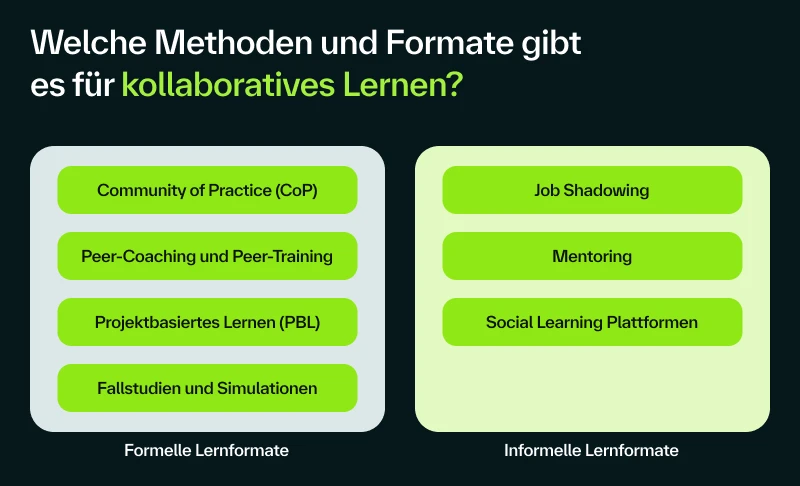
Formal learning formats
Structured formats provide a clear framework for collaboration and are particularly suitable when employees need to develop specific skills or solve complex tasks.
Community of Practice (CoP):
Informal groups of employees with common interests or areas of responsibility meet regularly to solve problems and deepen their knowledge. CoPs promote the continuous exchange of experiential knowledge and enable networking across departmental boundaries.
Peer coaching and peer training:
In peer-to-peer learning, employees learn directly from their colleagues. These formats leverage the expertise within the company and foster a trusting learning environment. The advantage is that peers understand the specific challenges of everyday work and can offer practical solutions.
Project-based learning (PBL):
Teams work together on real business problems. The learning process is closely linked to practical application. Employees develop professional skills and learn to work better together under time pressure.
Case studies and simulations:
Joint analysis of scenarios and collective decision-making train strategic thinking. Teams discuss different solutions, weigh up options, and reflect on their decisions. Ideal training for complex management tasks.
Informal learning formats
In addition to structured programs, informal learning plays a key role. These formats often arise from day-to-day work and promote the natural exchange of knowledge.
Job shadowing and mentoring:
With direct support from experienced colleagues, employees learn through observation and dialogue. Mentoring enables long-term learning relationships in which implicit knowledge is passed on and individual development is promoted.
Social learning platforms:
Digital tools such as forums, wikis, and communication platforms enable asynchronous exchange. Employees ask questions, share solutions, and discuss challenges, regardless of time and place. These platforms simultaneously document knowledge and make it accessible to others.
How does human resources development implement collaborative learning?
Human resources development plays a central role in establishing collaborative learning. It shapes the framework conditions, provides the necessary infrastructure, and empowers employees and managers to actively shape collaboration.
Concept and didactics
The development of effective learning architectures begins with the question: Which forms of interaction promote genuine collaboration? HR developers formats that deliberately provide space for exchange, joint reflection, and mutual feedback. The key is to find the right balance between structure and freedom in order to have enough guidelines for orientation and enough leeway for self-organized learning.
Tool and infrastructure provision
Digital collaboration tools are the backbone of modern learning formats. A Learning Experience Platform LXP), digital whiteboards, and communication platforms enable collaboration across locations. Human resources development selects suitable tools, introduces them, and ensures that employees can use them effectively.
Training of learners
Collaborative learning can only succeed if employees have the necessary skills. Training in communication, conflict resolution, and constructive feedback lays the foundation for productive collaboration. The ability to use digital tools and moderate group processes are also part of the toolkit of successful learners.
Empowering managers
Managers facilitate and promote collaboration within the team. They strengthen psychological security, encourage exchange, and intervene when cooperation stalls. Through coaching, targeted training, and the exchange of best practices, human resources development supports managers in actively fulfilling this role.
What are the success factors for collaborative learning?
Collaborative learning only reaches its full potential under certain conditions. Clear structures, the right group composition, sufficient resources, and the ability to deal with typical challenges are all crucial factors.
Success factors
Clear goals and distribution of roles:
If Learners know what they are working towards together, collaboration will fizzle out. Transparent goals and a clear distribution of roles within the learning group provide orientation and prevent misunderstandings.
Heterogeneity of the groups:
Diverse perspectives enrich the learning process. Groups that combine different experiences, expertise, and ways of thinking develop more creative solutions. Human resources development should consciously put together heterogeneous teams.
Sufficient time and resources:
Collaboration takes time, whether for coordination, discussions, or joint reflection. Companies should plan realistic time frames and give employees the necessary freedom to work together.
What challenges exist and how can they be solved?
Despite all its advantages, collaborative learning also presents obstacles that HR developers should HR developers and actively address.
Social loafing (free rider problem):
In groups, there is a risk that individuals will rely on the performance of others. Clear responsibilities, individual contributions, and transparent evaluations counteract this phenomenon. Group size also plays a role. Smaller teams encourage active participation.
Dealing with conflicts and different learning speeds:
Different working styles and learning speeds can lead to tension. It is therefore crucial to have an open culture of conflict resolution in which differences are addressed. Moderators or facilitators help to resolve conflicts constructively and keep the group on track.
The need for cultural change:
Collaborative learning requires a culture of openness and trust. Employees must be willing to share knowledge, admit mistakes, and learn from each other. This change takes time and must be actively modeled by managers.
How is the success of collaborative learning measured?
The success of collaborative learning is evident not only in completion rates, but above all in the quality of collaboration and the transfer of knowledge into practice. HR developers both qualitative and quantitative metrics to evaluate the impact.
Qualitative results
Improved team processes are a clear sign of successful collaboration. When teams make decisions faster, communicate more constructively, and resolve conflicts productively, collaborative learning pays off. The quality of problem solving can also be evaluated: Are more innovative solutions being developed? Do teams take different perspectives into account?
Feedback discussions, observations, and reflection sessions provide insight into these qualitative successes. Employees can assess for themselves how much they have benefited from the collaboration and what added value they see for their work.
Quantitative results
Measurable metrics complement the qualitative picture. Activity on learning platforms, such as forum posts, shared resources, or participation in discussions, shows how intensively employees collaborate. Completion rates for learning formats and participation in communities of practice provide further data.
The transfer rate is particularly important: Are employees applying what they have learned in their daily work? Surveys conducted after a few weeks or months provide indications as to whether they have been able to anchor the knowledge in the long term.
The contribution of PE to sustainable anchoring
Human resources development ensures that collaborative learning does not become a short-term project. Continuous evaluation, adaptation of formats, and integration into existing Development Programs a sustainable learning culture. Regular incentives, exchange formats, and recognition of collaborative successes maintain momentum.
Haufe Akademie: Strategically implementing collaborative learning solutions
In order to successfully establish collaborative learning, employees need the right infrastructure, well-designed formats, and ongoing support. Haufe Akademie HR developers solutions that enable them to promote collaboration in a targeted manner.
With the Learning Experience Platform , you Learning Experience Platform the digital foundation for social learning and peer-to-peer exchange. Employees follow individual learning paths, exchange ideas in communities, and benefit from collaborative features—flexible, scalable, and directly applicable in everyday work.
Your advantages at a glance:
- Social learning features for direct exchange between learners
- Communities of Practice for continuous collaboration
- flexible integration into existing learning structures
- Comprehensive reports for measuring engagement and learning success
- Content available in German and English
FAQ
What is collaborative learning?
Collaborative learning is a shared learning process in which Learners work together Learners a common goal and support each other. In contrast to individual learning, the focus is on the social construction of knowledge through interaction. All participants are jointly responsible for learning success.
What is the difference between cooperative and collaborative?
In cooperative learning, tasks are divided among individual team members, who work independently and then combine their results later. In collaborative learning, all participants work together continuously throughout the entire learning process. The group not only shares the results, but also develops knowledge through constant interaction and mutual support.
What are collaborative skills?
Collaborative skills include communication skills, active listening, giving constructive feedback, and a willingness to change perspectives. They also include conflict resolution skills, the ability to self-reflect, and empathy when dealing with different opinions. These skills enable employees to work together effectively in teams and develop solutions together.
You might also be interested in