T-shaped skills: combining versatility and in-depth knowledge

Specialists who work exclusively in their field of expertise are increasingly reaching their limits. At the same time, broad knowledge without in-depth expertise is not enough to master complex challenges. T-shaped professionals combine both: in-depth expertise in one area and the ability to think outside the box. For HR developers , the question HR developers : How can these sought-after skill profiles be systematically developed within the company? This article shows why T-shaped skills are becoming a decisive factor for success and how you can promote them in a targeted manner.
T-shaped skills: the most important facts in brief
- T-shaped skills combine deep expertise in a specialized field with broad interdisciplinary abilities.
- Teams made up of T-shaped professionals are more agile, innovative, and resilient because they break down silos, respond more flexibly to change, and develop creative solutions through a diversity of perspectives.
- This development requires a two-pronged approach: deepening specialist expertise through further training and mentoring, and expanding interdisciplinary skills.
- An open learning culture with fixed learning times, learning at the "moment of need," and trust in employees are crucial.
- Learning Experience Platforms provide systematic support through personalized learning paths, AI-powered recommendations, and visibility of expertise—for both dimensions of the T-model.
- In practice, T-shaped professionals are indispensable for agile teams, design thinking, modern marketing, and new roles.
What are T-shaped skills?
T-shaped skills describe a competency profile that combines deep expertise in a specialized field (vertical bar of the T) with broad interdisciplinary skills and contextual knowledge (horizontal bar). T-shaped professionals have expert-level mastery of their core subject area, but at the same time can communicate across disciplinary boundaries, think in different contexts, and collaborate effectively with colleagues from other fields.
The concept originated in software development and has since established itself as a fundamental principle for successful collaboration in agile, cross-functional teams.
Monja Eberlein, Learning Experience Strategist at Haufe Akademie, explains:
Most companies today do not know what challenges they will face tomorrow and what skills they will need within their organization in the future. T-shaped professionals can be key here because they can adapt relatively easily in the short term to new, unpredictable challenges and changing job profiles.
How does the T-model work?
The T-model visualizes two complementary dimensions of competence that together form an effective profile. Both axes are equally important. Without depth, credibility and problem-solving skills are lacking; without breadth, there is a lack of collaboration skills and contextual understanding.
The vertical bar: in-depth knowledge and expertise
The vertical bar represents the depth of expertise, the specialist area in which a person has built up expertise. This depth forms the foundation and includes:
- Sound theoretical and practical knowledge in your own field of expertise
- the ability to solve complex technical problems independently
- Credibility and trust as a contact person for the specialist area
- Continuous development of technical expertise
The horizontal bar: broad knowledge and interdisciplinary skills
The horizontal bar represents broad knowledge and the ability to think beyond one's own area of expertise. This breadth enables T-shaped professionals to actively shape cross-functional collaboration. This dimension includes:
- Basic understanding of related disciplines and subject areas
- Communication skills: explaining complex issues in a way that non-experts can understand
- Empathy and collaboration skills when dealing with different perspectives
- Contextual thinking: evaluating technical decisions in the broader corporate context


Why are T-shaped teams more successful?
T-shaped skills are most useful when working collaboratively. Teams consisting of T-shaped professionals work more efficiently, innovatively, and resiliently than teams consisting solely of specialists or generalists.
Added value for companies
Companies benefit from T-shaped professionals on several levels:
- Promoting agility and adaptability: Organizations respond more flexibly to change through T-shaped teams.
- Breaking down silos: An interdisciplinary approach reduces friction losses and improves cooperation between departments.
- Innovation through diversity of perspectives: The combination of in-depth knowledge and interdisciplinary thinking promotes creative problem solving.
- Greater competitiveness: Organizations are better prepared for complex challenges.
Added value for teams
At the team level, there are concrete advantages in everyday work:
- Improved collaboration in cross-functional projects such as Scrum or Design Thinking
- Greater resilience: Teams compensate better for absences, as members understand adjacent tasks.
- More efficient communication through a shared understanding of context
- Faster decision-making through interdisciplinary perspectives
Added value for individuals
Employees themselves also benefit from developing a T-shaped profile:
- better career development and long-term prospects
- Holistic understanding of one's own work in the corporate context
- Greater job satisfaction thanks to diverse tasks and prospects
- Stronger networking within the company and greater opportunities to exert influence
What other shaped models are available?
In addition to the T-shaped model, there are other competency profiles that describe different combinations of depth and breadth. Understanding these models helps HR developers choose the right development strategy for different roles.
I-Shaped: Specialists with in-depth knowledge
I-shaped professionals focus on deep expert knowledge in a narrowly defined field. They are true specialists, but have limited knowledge of related areas. This profile is suitable for highly specialized roles, but often reaches its limits in cross-functional teams.
Pi-Shaped: Dual Expertise
Pi-shaped professionals have deep expertise in two different fields plus broad contextual knowledge. This profile is particularly valuable for interdisciplinary roles, such as those at the intersection of technology and design or data analysis and marketing.
M-Shaped: Multiple Specialization
M-shaped professionals have developed expertise in three or more areas. This profile often develops over the course of a long career and enables them to take on a leading role in highly complex, interdisciplinary projects.
Generalists: breadth without depth
This group has broad knowledge in many areas without having built up real expertise in any one area. While they are flexible in their application, they often lack credibility and problem-solving skills in specific technical issues.
The T-shaped profile represents the optimal balance for many roles: it combines credible technical expertise with the ability to collaborate across functions. While I-shaped professionals work in silos and generalists lack depth, the T-shaped profile enables both independent technical work and collaborative team performance.
How do companies develop T-shaped professionals?
The development of T-shaped skills is a strategic process that requires both the deepening of specialist expertise and the targeted expansion of interdisciplinary skills. HR developers promote both dimensions through structured measures.
Strengthen the vertical bar: Deepen your expertise
The following approaches are suitable for deepening subject expertise:
- Specialized training and certifications in the core subject area
- Mentoring by senior experts and external specialists
- Project work with increasing complexity in a specialized field
- Allow time for in-depth research and continuous learning
- Participation in specialist conferences and exchange with the community
Expanding the horizontal bar: Developing interdisciplinary skills
Developing broad knowledge requires different approaches than deepening specialist expertise:
- Cultivating curiosity: Encouraging employees to look beyond their own area of expertise
- Cross-functional project work and job rotation
- Development of soft skills: active listening, empathy, communication
- Introductory courses in related disciplines (e.g., "Marketing for developers")
- Regular exchange with colleagues from other departments
What kind of learning culture do T-shaped skills require?
The successful development of T-shaped professionals requires an open learning culture that values both specialization and curiosity. Monja Eberlein emphasizes:
"I am convinced that an open and experimental learning culture saves time in the long run. Companies offer fixed learning days and support learning in the 'moment of need', i.e. during working hours when there is a specific need. Ultimately, a successful learning culture employees on trust in the employees ."
Specific measures for a T-shaped-friendly learning culture:
- Include fixed learning times in the employment contract
- Enabling learning at the "moment of need" during working hours
- Encourage employees to "dip their toes" into new topics
- Trust in employees' decision-making authority regarding their learning needs
Learning Experience Platform: Systematically developing T-shaped skills
A Learning Experience Platform (LXP) supports companies in developing T-shaped skill sets in a structured and scalable manner. Personalized learning paths enable employees to develop both their vertical expertise and horizontal skills in a targeted manner.
Monja Eberlein explains the approach:
"As a platform, LXP together all learning opportunities within an organization in one place. It offers a wide variety of formats—from small micronuggets to entire learning journeys. employees learn easily and seamlessly as part of their daily work routine, without complicated approval processes."
Modern learning platforms (LXP) enable:
- Individual learning paths for in-depth study and interdisciplinary continuing education
- AI-supported recommendation algorithm for personalized learning content based on interests and usage behavior
- Displaying current topics within the company can motivate people to "think outside the box."
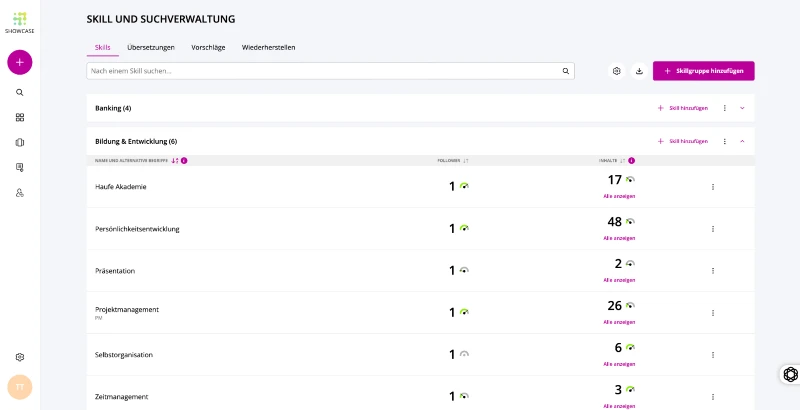
- Contact function for highlighting expertise within the company
- Statistical data for strategic management of learning needs and budget allocation
Where are T-shaped professionals indispensable?
T-shaped skills are particularly valuable in work environments that require interdisciplinary collaboration and rapid adaptability. The following examples show where T-shaped professionals create concrete added value.
Agile project management and Scrum
The T-shaped profile is particularly valuable in agile teams. A Scrum Master with T-shaped skills has in-depth knowledge of agile methods (vertical bar) and also understands how development, design, and product management work (horizontal bar). This combination enables them to effectively remove obstacles and orchestrate collaboration between different disciplines.
Design Thinking and User Experience
designers T-shaped skills are masters of their craft (user research, interface design) and also understand technical feasibility, business requirements, and marketing goals. This diversity of perspectives leads to solutions that are not only user-friendly, but also feasible and economically viable.
subject matter experts knowledge scouts: Enabling professional careers
An innovative example from practice shows how companies can specifically promote T-shaped skills while also creating professional career prospects. A mechanical engineering company has posted internal job advertisements forsubject matter expertsand "knowledge scouts." These are additional roles that employees can position for regardless of their current position
The responsibilities of these roles:
- Pass on existing expertise in core competencies or future fields
- research new knowledge in their field of expertise and prepare it for the organization
- Share LXP expertise LXP the entire organization
- be LXP as a contact person for your specialist topic via the LXP contact function
Outlook: Lifelong learning as a basic requirement
T-shaped skills are the result of continuous development. In a working world characterized by constant change, both vertical expertise and horizontal contextual knowledge must be constantly updated.
For HR developers , this HR developers promoting T-shaped professionals requires a learning culture that values both specialization and curiosity. Employees need time and space to deepen their expertise while also looking beyond their own horizons.
Haufe Akademie: Your partner for T-shaped skills
Haufe Akademie you in systematically developing T-shaped professionals—with solutions that promote both specialist knowledge and interdisciplinary skills and integrate continuous learning into everyday working life in a targeted manner.
The Learning Experience Platform LXP) as a technological basis:
- Personalized learning paths: individualized learning for vertical expertise and horizontal skills based on real tasks and identified skill gaps
- Skill transparency: systematicrecording of specialist expertise and interdisciplinary skills with a contact function to visualize T-shaped profiles
- Adaptive recommendations: AI-supported algorithm suggests both in-depth specialist content and cross-functional learning opportunities.
- A variety of formats: frommicro-nuggets to learning journeys; flexible learning at the moment of need without complicated approval processes
- Measurable success: detailedreports on learning progress, skill development, and strategic management of learning needs
Learning Experience Platform more about the Learning Experience Platform now
FAQ
Why are T-shaped skills so sought after in today's working world?
T-shaped professionals can adapt quickly to new challenges, build bridges between departments, and successfully coordinate interdisciplinary teams. This combination of technical expertise and collaborative skills makes them particularly valuable to modern organizations.
How does a T-shaped professional differ from pure specialists or generalists?
Pure specialists (I-shaped) have in-depth knowledge in a narrow field without interdisciplinary skills. Generalists have broad knowledge without real expertise. T-shaped professionals combine both: credible technical expertise plus cross-functional collaboration skills.
How can companies promote T-shaped skills among their employees?
Development requires a two-pronged approach: deepening technical expertise through continuing education, mentoring, and challenging projects, as well as building interdisciplinary skills through cross-functional project work, job rotation, and soft skills training. A learning experience platform systematically supports both dimensions with personalized learning paths.
You might also be interested in