
Digital learning trends 2025/2026: What will shape the future of human resources development?

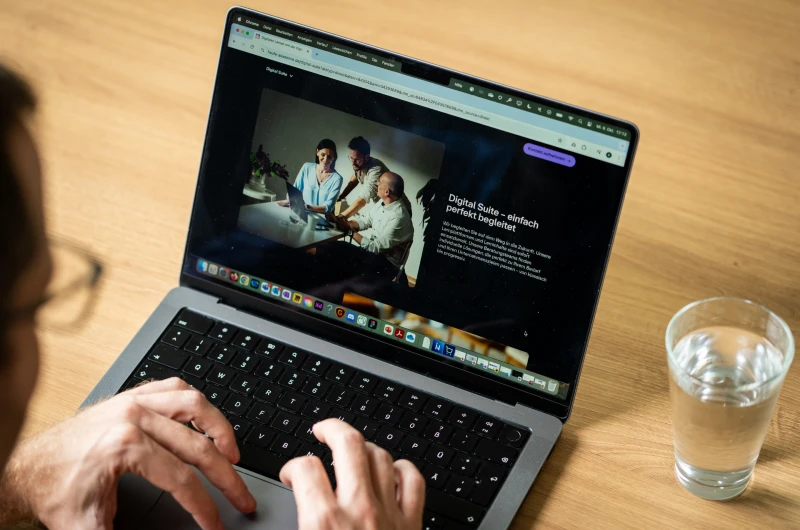
What does the future of digital learning look like? The latest BENCHMARKING Study 2025 provides concrete answers: artificial intelligence, hybrid learning models, and personalization dominate the agenda. However, there is often still a gap between strategic aspirations and actual practice. The good news is that digital learning has become established. Almost half of companies see it as a central component of their continuing education strategy. The challenge is that a lack of time, resources, and personalization are slowing down its impact. This article shows which developments will be decisive for human resources development in 2025 and 2026.
Digital learning trends 2025/2026: The most important facts in brief
- AI-supported learning paths lead the way in future topics: 82.5% of companies see AI and adaptive learning systems as the greatest lever for successful personnel development.
- Hybrid learning models combine flexibility with didactic depth and are already standard: 80.3% use them, with a further 11.8% planning to introduce them.
- Personalization is becoming a factor for success: 64.8% expect that individualized learning opportunities will measurably increase the impact of continuing education.
- Microlearning in everyday work: 60% rely on short learning units that can be seamlessly integrated into the workflow.
- Measurability is becoming increasingly important: 32.1% will use performance measurement as the basis for investment decisions in the future.
- Time remains the biggest hurdle: 81.8% cite a lack of learning time in their everyday working lives as a key obstacle.
Where does digital learning stand today?
The figures show that digital learning has arrived. According to the BENCHMARKING Study 2025, 48.8% of the companies surveyed see it as a central component of their continuing education strategy, while another 31.6% use it as a supplement.
But what goals are companies pursuing with digital learning formats? Flexibility is the top priority: 79.7% cite increasing learning flexibility as their main goal. This is closely followed by cost savings (76.9%) and integrating learning into everyday work (63.7%). Continuing education must become more efficient without losing its impact.

However, there is a gap between these ambitious goals and actual practice. The biggest challenge? Time. 81.8% report that employees have too little freedom for further training. Added to this are a lack of internal resources (46.0%), technical problems (41.9%), and insufficient personalization (42.9%).
The paradox: digital learning is supposed to bring more flexibility, but often fails because this flexibility is not realized in everyday working life.


5 trends shaping digital learning in 2025/2026
What lies ahead for HR developers the coming years? The study identifies five clear trends that will have a lasting impact on digital learning:
- AI and adaptive learning systems are revolutionizing personalization
- Microlearning conquers everyday working life
- Personalization becomes a competitive factor
- Hybrid models as the new standard
- Learning platforms are becoming a strategic tool
1. AI and adaptive learning systems are revolutionizing personalization
At 82.5%, artificial intelligence clearly tops the list of future topics. Companies hope that AI will enable individual learning paths that automatically adapt to prior knowledge, learning progress, and skill gaps.
AI-supported, adaptive learning systems recognize which topics an employee has already mastered, skip familiar content, and offer appropriate exercises to fill knowledge gaps. The result: everyone learns at their own pace, without being under- or overchallenged.
63.2% are convinced that AI can measurably increase learning success. 52.9% see it as a tool for precisely identifying skills gaps.
2. Microlearning conquers everyday working life
60% of companies rely on microlearning. Short learning units lasting 5 to 15 minutes are easier to integrate into everyday work than courses lasting several hours. The trend is clearly moving toward "learning in the flow of work": learning becomes part of daily work, rather than a separate block in the calendar.
Microlearning is particularly effective for just-in-time knowledge, i.e., when employees learn exactly when they need the knowledge.
3. Personalization becomes a competitive factor
64.8% expect personalized learning opportunities to become significantly more important in the coming years. Currently, however, 42.9% see this as a key weakness. This discrepancy highlights the enormous potential.
True personalization goes far beyond individual learning paths. It includes:
- Adaptive learning paths based on prior knowledge and learning objectives
- Intelligent recommendations based on learning behavior and preferences
- flexible formats depending on learning type (video, text, interactive, audio)
- relevant content for the respective role, industry, and task
- individual learning pace without time pressure due to rigid course schedules
46.1% of companies see personalized learning experiences with measurable results as a clear advantage. The reason: when learning opportunities are truly tailored to the individual, not only does motivation increase, but so does actual learning success.
4. Hybrid models as the new standard
80.3% already use hybrid learning models, with a further 11.8% planning to introduce them. The advantages: flexibility (65.4%), reduced travel times (57.0%), and the targeted combination of theory and practice (53.6%).
Success depends on the right combination. 55.8% use face-to-face sessions specifically for interactive content, while e-learning formats are used for knowledge transfer. The challenges lie in coordination (54.6%) and technical implementation (36.9%).
5. Learning platforms are becoming a strategic tool
53.2% see better integration of learning platforms as a key driver. The expectation: Learning platforms are evolving from content libraries into intelligent learning ecosystems with AI-based recommendations, seamless IT integration, social learning features, and comprehensive analytics. Additionally, 43.0% expect measurable learning outcomes from interactive and gamified learning formats. Gamification elements can boost motivation when used effectively.
Measuring success: From "nice to have" to "need to have"
Measurability is becoming increasingly important. Currently, most companies still use simple metrics: 38.7% measure participation and completion rates, while 27.5% collect feedback.
However, change is on the horizon. 32.1% believe that measuring success will become central to investment decisions in the future. There is a demand for key figures that reveal the actual contribution to corporate success—the ROI of continuing education: gains in competence, transfer to everyday work, and business impact.
How can this be implemented in practice?
Knowing trends is one thing, successfully implementing them is another. Here are five specific recommendations for action with practical tips.
Create real learning time
The biggest obstacle is lack of time (81.8%). Many companies rely on flexible, digital formats. But when there is a fundamental lack of time, even flexibility doesn't help.
What really helps: Establish fixed learning times in your daily work routine, such as "Learning Fridays" with two protected hours per week. Make learning time a management task and use microlearning for short units in between. Integrate learning directly into work processes, for example through short explanatory videos in tools that employees use anyway.
Invest in personalization
42.9% currently see shortcomings in the personalization of learning content, while 64.8% expect great potential for the future. This gap between the current situation and the target situation offers real opportunities for companies that act now.
Concrete steps: Start with a needs analysis: Which skills are required for which roles? Utilize intelligent learning platforms with recommendation algorithms and offer content in various formats. Continuously measure what works and start with pilot groups.
Design hybrid learning systematically
80% already use hybrid learning, but not always systematically. Success depends on effectively integrating digital and face-to-face phases.
Best practice: Use digital formats for knowledge transfer and fundamentals. Reserve face-to-face sessions for in-depth study, discussion, and practical exercises. Use microlearning units for preparation or follow-up between the two phases.
Build measurability systematically
If success measurement determines budgets in the future, you need meaningful key figures now.
Recommended metrics: Completion rates and learning times show at the process level how learning opportunities are used and completed. Before-and-after tests reveal the progress made at the competency level. Application rates illustrate at the behavioral level how often new skills are actually used in everyday work. Measurable effects on KPIs such as productivity or employee retention show at the business level how the measures contribute to the company's success.
Get executives on board
43.7% see a lack of support from managers as an obstacle to effective learning. Without active encouragement, even the best learning opportunities will come to nothing.
How to win over managers: Present the business case for continuing education and make learning support a management responsibility. Offer managers their own continuing education courses on the topic of learning support, provide incentives, and communicate success stories from practice.
Haufe Akademie: Shaping the future with modern human resources development
The trends are clear, but implementation is complex. With decades of experience in the continuing education market and innovative learning technologies, Haufe Akademie supports you Haufe Akademie making your personnel development fit for the future.
Our solutions for your challenges:
- Learning platforms: with the LXP increase the pace of learning within your company, analyze employee needs, and leverage change as a competitive advantage. And with the Haufe AkademieLearning Management System LMS), efficiently organize, manage, and document continuing education
- Curated content libraries: flexible learning nuggets on leadership, management, and specialist topics, specially designed for microlearning and immediately applicable
- hybrid Development Programs: digital learning phases for flexibility, face-to-face modules for consolidation and networking, accompanying coaching for sustainable transfer
- Tailored solutions: flexible, scalable, and tailored to your goals, with measurable results to support your arguments to stakeholders.
Conclusion: The future of learning is personalized, hybrid, and measurable.
The trends for 2026 are clear: AI is a strategic success factor, hybrid models are the new normal, and measurability is becoming a must. You don't have to implement everything at once – start with what is most urgent for your company. If you act now, you will secure a competitive advantage in the qualification of your teams. Use the findings of the study as a compass for your own strategy and actively shape the future of your human resources development.
FAQ
What trends will shape digital learning in 2025 and 2026?
The most important trends are AI-supported adaptive learning systems, personalized learning offerings, microlearning, and hybrid learning models. Artificial intelligence is seen as the greatest lever for optimizing learning paths and closing skills gaps in a targeted manner.
How widespread are hybrid learning models and what advantages do they offer?
According to the BENCHMARKING Study 2025, 80.3% of companies already use hybrid learning models, with a further 11.8% planning to introduce them. The biggest advantages are flexibility, reduced travel times, and the combination of theory and practice. The main challenges lie in coordinating schedules and resources, as well as technical implementation. Success depends on systematically integrating digital and face-to-face phases.
What are the biggest challenges in digital learning?
The biggest hurdle is time: the BENCHMARKING Study 2025shows that 81.8% report that employees have too little freedom for further training. Other key challenges include a lack of internal resources, insufficient personalization, technical problems, a lack of motivation among participants, and a lack of support from managers.
You might also be interested in

