Learning Experience Design: From e-learning to a genuine learning experience


Why do employees enthusiastically take advantage of some learning opportunities while ignoring others? The difference rarely lies in the content, but rather in the learning experience. Learning Experience Design (LXD) applies the principles of user experience design to learning processes: the focus is on the learners, and their needs determine the design. Instead of asking "What should they learn?", LXD asks "How do they experience learning?" and transforms passive knowledge consumption into motivating experiences that have an impact on everyday work.
Learning Experience: The most important facts in brief
- Learning Experience Design (LXD) puts learners at the center and designs learning as a motivating experience rather than purely imparting knowledge.
- Unlike instructional design, the focus is not on the "what" but on the "how." The experiences and emotions of the learners determine the design.
- The LXD implementation process comprises four phases: understanding, designing, creating, and testing—iteratively and based on design thinking.
- A Learning Experience Platform LXP) offers personalized, self-directed learning paths, while an LMS provides LMS administrative structure and learning platform functions.
- LXD measurably increases acceptance and transfer: learning opportunities are used more intensively and what has been learned is applied more quickly in everyday work.
What is learning experience design?
Learning Experience Design refers to the process of designing learning environments to meet the needs and context of learners. At its core, it is about understanding learning as an experience and not just as the transfer of knowledge. LXD combines insights from cognitive science, motivational psychology, and user experience design.
Unlike traditional e-learning approaches, LXD does not focus primarily on providing content digitally. Instead, it creates a well-thought-out learning experience that extends from the first contact with learning content to its successful application in everyday work. This approach makes the difference between learning opportunities that are ignored and those that trigger genuine engagement.
What is the difference between LXD and instructional design?
Both approaches aim to develop effective learning solutions. However, they differ fundamentally in their approach.
- Instructional design (ID) focuses on the question: What is being taught? The starting points are learning objectives and didactic models. ID systematically plans how knowledge is effectively conveyed, often using a linear structure.
- Learning Experience Design (LXD), on the other hand, asks the question: How do Learners experience Learners process? The starting points are the needs, context, and motivation of the learners. LXD works iteratively with prototyping and feedback loops.
The shift in focus is crucial: while ID focuses on content and structure, LXD emphasizes experience and emotion. Both approaches can complement each other: ID provides the didactic structure, while LXD ensures an appealing, user-centered implementation.
These principles make LXD successful
Successful learning experience design is based on four principles for motivating and practical learning opportunities.
1. Learner-centeredness: Focus on the learners
The most important principle is: understand the learners. Who is the target audience? What problem does the learning program solve? In what context does learning take place? Developing learner personas helps to accurately identify needs and create relevant learning experiences.
2. Design thinking in the learning process
LXD uses design thinking to develop solutions that work. The iterative process consists of five phases:
- Empathize: Learners
- Define: Formulate learning needs
- Ideate: Develop solutions
- Prototype: creating testable versions
- Test: Gather feedback and optimize
3. Utilize psychological principles
Effective learning experiences take into account how people learn and what motivates them. Motivational psychology distinguishes between intrinsic motivation (learning on one's own initiative) and extrinsic motivation (learning through external incentives).
Cognitive science provides insights into chunking (dividing information into digestible units), spaced repetition (repeating information at intervals), and cognitive load (reducing cognitive strain).
4. Relevance and context: Learning in the flow of work
Integrating learning into everyday work is a key feature of LXD. Learning in the flow of work means that employees learn exactly when they need the knowledge. Microlearning and learning nuggets (short, focused learning units) enable learning at the moment of need.
How to implement LXD in practice
The concrete implementation of learning experience design in human resources development follows a four-step process. This process applies design thinking principles to practical work and structures the path from analysis to final implementation.
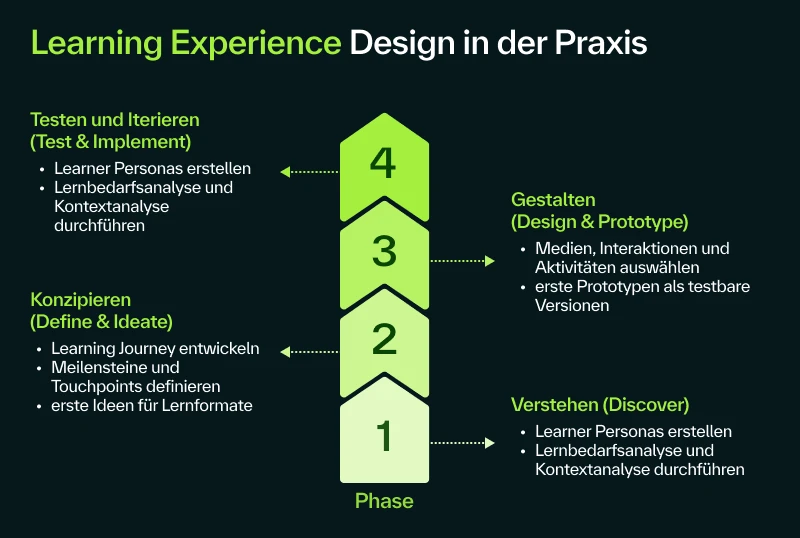
Phase 1: Discover
You create learner personas for typical user groups and conduct a learning needs analysis from the user's perspective. The context analysis clarifies where, when, and how employees learn: during work, on the go, or at fixed learning times.
Phase 2: Design (Define & Ideate)
You develop the learning journey, i.e., the path from initial contact with the learning content to its application. You define milestones and touchpoints and develop initial ideas for learning formats such as microlearning, social learning, or simulations.
Phase 3: Design (Design & Prototype)
You select media, interactions, and activities that are appropriate for the target group and learning objective. Examples include microlearning modules, simulations, peer feedback, and collaborative formats. In this phase, initial prototypes are created as testable versions that bring the concept to life.
Phase 4: Testing and iteration (Test & Implement)
They test prototypes with a small test group, gather feedback, and evaluate usage data. This iterative approach ensures that the final learning platform or learning path works and is accepted.
Why LXD is becoming a strategic advantage
Learning Experience Design is a strategic lever for successful human resources development. Companies that use LXD benefit in several ways:
- Increased acceptance: When learning opportunities match the needs of learners, participation and completion rates increase significantly.
- Improved learning transfer: LXD links learning content and work performance even more closely. Employees apply what they have learned more quickly.
- Attractiveness as an employer: High-quality learning opportunities are an employer branding factor and show that you invest in development.
- Increased efficiency: By testing early and discarding ineffective ideas, you reduce development costs.
- Measurability (Learning analytics): User-centered KPIs such as engagement rate or application rate enable better measurement of success.
What tools and platforms do you need for LXD?
From planning and implementation to measuring success: modern technologies support you in implementing learning experience design. Various platforms and tools play an important role in this.
Learning Experience Platforms
Learning Experience Platforms (LXP) put learners at the center. They enable self-directed, personalized learning with adaptive learning paths that adjust to individual needs.
Learners content based on their interests and needs, discover new topics, and receive recommendations based on their behavior. The platform learns as they learn and suggests relevant content.
Learning Management Systems
Learning Management Systems (LMS) provide the basis for managing and tracking learning processes in a structured manner. They organize courses, coordinate registrations, track progress, and generate reports.
While the LXP on the learning experience and self-management, the LMS administrative structure and compliance. Both systems complement each other and together form a comprehensive learning environment.


Prototyping and collaboration tools
Prototyping tools are indispensable if you want to develop and iterate learning experiences quickly. They enable you to visualize and test ideas without having to go through a complex development process.
Collaboration platforms help agile teams work together on learning solutions.
Analytics tools provide data on how learning opportunities are used and how successful they are—an important basis for continuously optimizing the learning experience.
What does a learning experience designer do?
Learning experience designers user-centered learning solutions. They analyze learning needs from the perspective of learners, design learning journeys, and implement them using appropriate tools. They work at the interface between human resources development, IT, and specialist departments.
The role is constantly evolving: while traditional HR developers plan learning content, learning experience designers create designers . Some companies are already creating positions such as "LXD Lead" or "Chief Learning Experience Officer."
Required skills
Learning experience designers a broad range of skills:
- Empathy and user research: You understand how Learners and act.
- Visualization and storytelling: They bring learning content to life.
- Agile working: You test early, gather feedback, and adapt solutions.
- Didactic knowledge: You know how learning works and which methods are effective.
- Technical understanding: You are familiar with digital learning tools and use them in a targeted manner.
Better learning experiences Haufe Akademie
Effective learning experiences are not created by good concepts alone. They require the right technological basis and content that really inspires. Haufe Akademie you Haufe Akademie the foundation you need to establish learning experience design in your company on a long-term basis.
- Our Learning Experience Platform LXP) enables personalized learning processes that employees control themselves.
- The Learning Management System LMS) ensures structured organization and seamless tracking.
- With the Content Kit , you receive modular learning nuggets that you can combine to create customized learning paths.
What you get out of it:
- Solutions that grow with your business, regardless of size
- Content that can be directly integrated into everyday work
- Seamless integration with your existing systems
- Continuous updates that reflect current learning trends
- Consulting on equal terms for your specific requirements
FAQ
What advantages does learning experience design offer over traditional e-learning?
LXD focuses on the entire learning experience, not just on providing content. This leads to greater engagement, better completion rates, and stronger transfer into practice. Employees find learning relevant and motivating because it suits their needs.
How do I measure the success of learning experience design?
In addition to traditional completion rates, you use user-centered KPIs: engagement rate (how actively do Learners use Learners offering?), time on task (how long do they spend on content?), application rate (do they apply what they have learned?), and qualitative feedback from surveys or interviews.
What role does a Learning Experience Platform LXP) play in LXD?
An LXP the technical foundation for personalized learning paths. It enables self-directed learning, adapts content to individual needs, and provides recommendations based on user behavior. This makes the learning experience relevant and motivating.
How long does it take to implement learning experience design?
That depends on the scope. Quick wins such as optimizing individual learning modules can be implemented in a few weeks. The complete transformation to an LXD-oriented learning culture (with new processes, tools, and skills) can take several months. The iterative approach makes it possible to start gradually and continuously improve the learning solutions.
You might also be interested in