Agile learning: Shaping sustainable personnel development


Traditional learning programs are reaching their limits. Long development cycles, rigid educational concepts, and months of planning are no longer compatible with the dynamics of modern working environments. Employees need solutions that are quickly available and can be used immediately. Agile learning applies proven principles from the agile working world to the learning process, thereby fundamentally changing the role of human resources development: it is evolving from content creator to facilitator, supporting and enabling learning rather than controlling it centrally. But what does this mean in concrete terms, and how does agile learning work in practice?
Agile learning: The most important facts in brief
- Agile learning combines the logic of agile working methods with modern learning processes and creates space for flexible, needs-based development.
- Five principles characterize agile learning: iterative approach, continuous feedback (inspect and adapt), customer centricity and focus on value creation, and a culture of error.
- Methods such as microlearning, peer learning, learning sprints, self-organized learning, and curated learning paths promote flexible learning at the moment of need.
- Human resources development is transforming from content creator to facilitator, designing flexible learning architectures instead of developing individual training courses.
- Success is measured by value contribution, not attendance. Agile KPIs such as application rate, team velocity (average amount of work a team successfully completes per sprint), and transfer rate show the actual business impact.
What is agile learning?
Agile learning applies the principles of agile working methods to the learning process. It focuses on flexibility, short iterations, and rapid adaptation to changing needs. The Learners is at the center Learners a "customer," whose actual needs determine the design of the learning process.
The VUCA world is changing learning requirements
Volatility, uncertainty, complexity, and ambiguity (VUCA) characterize modern work environments. Markets are changing faster than ever before, technological change is accelerating, and global interconnectedness is creating new challenges. In this environment, traditional learning approaches no longer work:
- Annual plans are outdated: by the time they are implemented, requirements have long since changed.
- Months of development: Curriculum development takes too long for fast-moving markets.
- Rigid classroom training: Standardized training courses rarely meet current needs.
- Lack of flexibility: Companies cannot respond to unforeseen developments.
Agile Manifesto as a foundation
Agile learning is derived from the four core values of the Agile Manifesto, which were originally formulated for software development:
- Individuals and interactions over processes and tools: The focus is on learners and their needs, not on the perfect learning management system.
- Functional solutions through comprehensive documentation: Applicable skills count for more than theoretical concepts and certificates.
- Collaboration on contract negotiations: Participation and co-creation in the learning process replace top-down specifications.
- Responding to change by following a plan: Flexible adaptation is more important than rigid adherence to fixed curricula.


What principles shape agile learning?
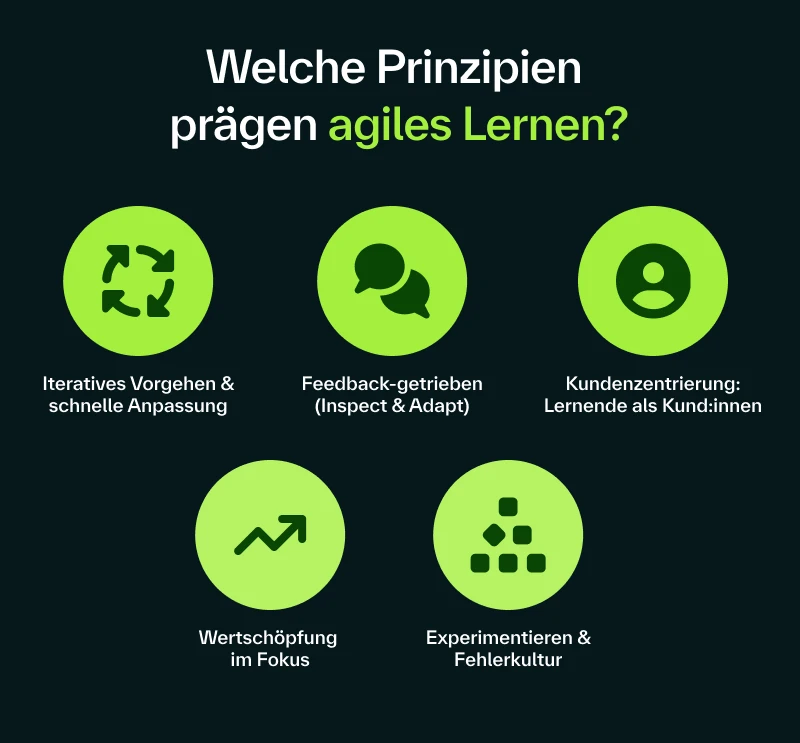
Agile learning is based on five key principles: iterative processes with rapid adjustment cycles, continuous feedback, consistent customer focus, a focus on value creation, and a culture of error tolerance that encourages experimentation. These principles ensure that learning is directly linked to the actual needs of employees.
Iterative approach & rapid adaptation
Instead of master plans that span years, agile learning relies on short learning cycles, also known as sprints. These typically last between one and four weeks and focus on specific learning goals. At the end of each cycle, there is a reflection: What worked? What needs to be adjusted? Continuous adjustment allows companies to respond flexibly to current needs instead of sticking to rigid annual plans.
Feedback-driven (Inspect & Adapt)
Continuous evaluation of learning content and methods is at the heart of agile learning. Regular feedback loops after each learning unit or sprint provide valuable insights. Adjustments based on feedback are made immediately, rather than after a program has been completed. Inspect & Adapt becomes an integral part of the learning process and supports continuous improvement in real time.
Customer focus: Employees as "customers"
In agile learning, employees are customers of the learning process. This means focusing on actual needs rather than assumptions about what should be learned. The key question is: What do learners really need to do their jobs better? Practical solutions for everyday work take priority over theoretical concepts. Learners actively involved in the design process and can help decide what, how, and when they learn.
Focus on value creation
Each learning objective must deliver direct, measurable added value. The focus is on practical application, not on collecting certificates. The relevance to daily work determines the selection of learning content. This outcome focus differs fundamentally from traditional output thinking, where the number of training courses completed is considered an indicator of success.
Experimentation & error culture
Agile learning sees trial and error as an integral part of the learning process. Psychological safety enables learning experiments without fear of negative consequences. Mistakes are understood and used as learning opportunities. This creates continuous improvements that accelerate innovation and competence building.
What methods and formats does agile learning use?
Agile learning relies on a combination of flexible formats: microlearning for quick knowledge needs in day-to-day work, peer learning for knowledge sharing, learning sprints for structured development, self-directed learning for empowerment, and curated learning paths for individual development. These formats are combined and adapted as needed.
Microlearning
Microlearning breaks down complex topics into small, easily digestible learning units lasting 5 to 15 minutes. These nuggets can be used flexibly in everyday work, exactly when the need arises. Typical formats include video nuggets, infographics, interactive tutorials, and audio snippets. The big advantage is that employees can learn exactly what they need for their current task.
Peer learning & collaboration
Leveraging collective intelligence within the team is a key success factor for agile learning. Peer learning promotes the exchange of knowledge between colleagues on an equal footing. Communities of practice bring people with similar interests together to share experiences and learn from each other. Collegial coaching encourages employees to support and develop each other. These forms of collaborative learning not only impart knowledge, but also strengthen team cohesion.
Learning sprints & blended learning
Learning sprints combine short, intensive face-to-face phases with flexible digital modules. This blended learning structure provides a structured framework while leaving room for individual focus areas. Skills develop iteratively within defined cycles.
Practical example: Leadership Sprints at Haufe Akademie
The Leadership Sprints at Haufe Akademie how agile learning works in leadership development:
- Compact attendance modules: intensive exchange and joint learning
- Digital learning phases: flexible consolidation at your own pace
- Clear sprint goals: structured completion of each cycle with reflection
- Peer learning: Managers learn from each other
- Continuous feedback: Adjustment based on feedback
This structure enables learning in short cycles and gradual advancement of one's own development. The result: sustainable behavioral change instead of short-term knowledge gain.
Self-organized learning
Employee empowerment is at the heart of self-directed learning. Learners responsibility for their own development and choose for themselves what they want to learn, when, and in what format. Human resources development creates the framework for this: access to resources, time to learn, and support when needed. Autonomy in choosing learning formats and pace increases intrinsic motivation and leads to more sustainable learning success.
Curated learning paths
Human resources development is fundamentally changing its role, shifting from trainer of curated learning paths. Instead of creating all content itself, human resources development selects the best available resources and makes them available as curated learning paths. It combines formats such as microlearning nuggets, webinars, and specialist articles to create individual learning journeys. This increases quality and makes more efficient use of existing resources.
How is the role of human resources development changing?
Human resources development is increasingly taking on the role of a facilitator who moderates learning processes and coach teams as coach agile coach . Instead of creating content, human resources development designs flexible learning architectures, organizes self-directed learning, and provides coach.
Strategic change: From content creation to learning support
The transformation of the role of human resources development is fundamental. Where training courses used to be developed, curricula written, and presentations created, the focus today is on enabling learning:
- Transition to the role of learning architects
- Focus on support and dialogue instead of instruction and lectures
- Removing barriers and providing resources as enablers
Designing learning architecture: The technological basis
A flexible infrastructure is essential for agile learning. The combination of Learning Experience Platform LXP) and Learning Management System LMS) supports rapid adjustments without the need for complex IT projects. LXPs offer personalized learning recommendations and seamlessly integrate different learning formats. LMS of administration, documentation, and compliance verification. Together, they provide access to curated resources and drive the development of individual learning paths.
Coaching & Mentoring: Providing targeted support for development
Instead of imparting knowledge, personnel development builds skills among the workforce. It promotes self-organized and reflective learning through targeted stimuli and questions. It acts as a learning guide that provides support when needed but is not constantly present. Mentoring programs connect experienced employees with learners and create development partnerships that go beyond formal training.
Resource management: Creating time and space
Agile learning requires resources. Human resources development ensures that time and space are created for feedback, experiments are possible, and structures for continuous learning are established. Specifically, this means anchoring learning times in everyday work, providing budgets for external resources, and providing spaces for exchange.
How is the success of agile learning measured?
Success in agile learning is measured not by attendance, but by the actual value contribution of employees. Agile KPIs such as feedback rate, application rate, and improvement in team velocity show the business impact. Short feedback loops trigger continuous improvement.
From output to outcome
Traditional metrics such as participant numbers, hours completed, or satisfaction ratings fall short. In agile learning, it is the value contribution that counts:
- Application rate: Is what has been learned being put into practice?
- Business Impact: How does learning affect business results?
- Behavioral change: Are there measurable changes in employees?
- Sustainability: Will the learning success last in the long term?
Establish agile KPIs
Agile learning requires new metrics that capture actual benefits:
Continuous assessment
Short feedback loops are at the heart of agile performance measurement. Check-ins with learners after each sprint provide qualitative insights. The formats are continuously optimized with the help of this feedback. Similar to agile project teams, learning teams reflect regularly:
- What's going well?
- What can we improve?
- What obstacles do we need to overcome?
This continuous evaluation makes the learning system itself a learning system.
Haufe Akademie: Designing agile learning processes together
The Haufe Akademie you embed agile learning in your organization. With the Digital Suite , you Digital Suite a comprehensive learning infrastructure that combines flexibility and scalability. The Learning Experience Platform enables personalized learning paths, the Haufe AkademieLearning Management System LMS) ensures structured management, and the e-learning courses in the Content Collection and the more than 2,000 Learning Nuggets from the Content Kit offer ready-to-use content. The Leadership Sprints demonstrate how agile learning works in practice.
Our solutions are tailored to your business objectives. As an equal partner, we contribute our many years of experience in personnel development and support you in promoting growth, unlocking potential, and ensuring long-term competitiveness.
Your advantages at a glance:
- flexible learning architecture for quick adjustments
- Scalable business solutions size
- Practical content with direct transferability
- Measurable results through agile KPIs
- Partnership-based support during implementation
- Integration into existing systems and processes
Digital Suite more about Digital Suite now
FAQ
What advantages does agile learning offer companies?
Agile learning enhances adaptability in dynamic markets, fosters motivation through self-direction, and improves the application of knowledge in practice. Companies benefit from faster skill development, higher employee retention, and greater responsiveness to change.
How long does it take to implement agile learning?
The introduction usually takes place gradually over a period of 6 to 18 months. Pilot projects often start after two to three months of preparation. Full integration into the culture and work organization is an ongoing process, with initial successes creating early acceptance.
Is agile learning suitable for all industries?
Agile learning can be used across all sectors, from industry and services to the public sector. Methods and formats are adapted to the respective requirements. Sectors with a high degree of change and complex tasks benefit particularly from this approach. Agile learning is also possible in regulated environments if compliance is integrated into the learning architecture.
You might also be interested in