
Digitalization and Sustainability: Shaping the Twin Transformation


In many companies, digitalization and sustainability are still treated as separate entities: The IT department drives new technologies forward, while the sustainability team handles climate goals and reporting requirements. Yet the success of both initiatives is increasingly interdependent. The Twin Transformation combines digital and sustainable development into a single strategy, making both truly effective. In this article, learn how these two topics are connected, where the greatest opportunities and risks lie, and how HR developers is embedding the Twin Transformation step by step within their company.
Digitalization and Sustainability: Key Points at a Glance
- Digitalization and sustainability together form the “Twin Transformation” and can only be effectively managed when addressed together.
- Digital applications such as smart grids, product passports, environmental monitoring, and AI-driven logistics support sustainability in many areas. However, truly sustainable digitalization can only be achieved through a focus on the entire life cycle, fair supply chains, and robust governance.
- The greatest risks are energy demand, raw material consumption, and the rebound effect, in which efficiency leads to increased rather than decreased consumption.
- Companies implement the Twin Transformation in six steps, from conducting an initial assessment to scaling successful pilot projects.
- Digital skills, sustainability skills, systems thinking, and the ability to collaborate across departments are in demand.
- Clear metrics and a brief practical assessment show whether digital projects contribute measurably and economically to sustainability.
Twin Transformation: How Do Digitalization and Sustainability Interact?
Digitalization and sustainability influence each other. Digital technologies help conserve resources, optimize processes, and make sustainability goals measurable: A sensor in a warehouse detects energy waste, or analytics software reveals the carbon footprint of a supply chain. At the same time, data centers, cloud services, and AI applications themselves consume energy and raw materials.
"Twin Transformation" refers precisely to this joint management of both effects: Companies no longer develop their digital and sustainability strategies separately, but rather as a single initiative with shared goals. For example, a logistics company that optimizes routes using AI not only saves fuel but also provides reliable data for its sustainability report and for its employee development management.
This connection is becoming increasingly important right now. Regulatory requirements for sustainability are growing, and at the same time, digital technologies are permeating more and more business processes—from production to human resources development. Those who view these two issues in isolation miss out on potential cost savings or expose themselves to unexpected risks, such as rising energy demand due to new AI applications or unclear responsibilities between the IT and sustainability teams. In contrast, companies that actively shape the Twin Transformation secure a clear economic advantage: they reduce costs, meet reporting obligations early, and strengthen their “ position ” among customers and investors. This is precisely where the strategic value of the Twin Transformation for human resources development lies.


In what ways do digital technologies support sustainability?
Digitalization offers three key levers for sustainability: better data, greater transparency, and automated optimization. Digital technologies for sustainability range from sensors and cloud platforms to artificial intelligence, and they reveal where resources are being wasted or processes are running inefficiently. Digitalization for sustainability, therefore, means using digital technologies in a targeted way to achieve environmental and social goals, rather than using them merely as an end in themselves. This is evident in a wide variety of areas:
- Energy Efficiency: Smart grids intelligently coordinate electricity generation and consumption. This ensures that energy is used when it is available and helps reduce particularly high loads on the power grid.
- Circular Economy: Digital product passports document the materials and components that make up a product. This facilitates repairs, the reuse of individual components, and recycling.
- Supply Chain Transparency: Digital environmental monitoring makes it possible to track emissions and resource consumption throughout the entire supply chain, rather than relying on estimates.
- Logistics and the Cloud: AI-powered route planning can optimize driving routes, thereby reducing fuel consumption and empty runs. Digital infrastructure also offers opportunities for savings: Cloud solutions can provide computing capacity on an as-needed basis, thereby avoiding unused resources. In day-to-day office work, digital collaboration can also help reduce business travel.
What Makes Digitalization Sustainable?
These applications demonstrate the potential of digitalization for sustainability, but they do not yet guarantee sustainable digitalization. Sustainable digitalization only emerges when a solution takes energy and material requirements into account throughout the entire life cycle, ensures fair working conditions in the supply chain, and has a governance structure that firmly embeds sustainability goals in decision-making rather than merely mentioning them. The next chapter focuses precisely on this flip side of sustainability and digitalization.
What risks and conflicting objectives must companies be aware of?
Digitalization is not automatically sustainable. While digitalization and climate protection are not fundamentally at odds with one another, digital technologies themselves can have significant environmental impacts. Without targeted management, this can give rise to new conflicts of interest and prevent sustainability goals from being met. Three areas of risk therefore deserve special attention:
- Energy and Water Requirements: Data centers, cloud infrastructures, and AI applications in particular require a great deal of electricity and cooling water. Companies should therefore take the energy requirements of new digital solutions into account from the very beginning and, whenever possible, rely on energy-efficient hardware, resource-conserving IT operations, and renewable energy.
- Raw Materials and Electronic Waste: Digital devices are made from critical raw materials, the extraction of which can have significant environmental and social impacts. At the same time, the disposal of end-of-life devices places a burden on the environment. Sustainable procurement therefore takes into account the entire life cycle—from manufacturing and use to reuse and recycling. The growing volumes of electronic waste highlight how important a functioning circular economy is, especially when it comes to hardware.
- Rebound effect: Efficiency gains from digitization often lead to higher rather than lower consumption—for example, when cheaper cloud storage encourages the collection of larger amounts of data, or when faster processors lead to more frequent device replacements. This boomerang effect demonstrates why sufficiency—that is, the conscious decision to avoid unnecessary consumption—plays just as important a role as technical efficiency.
These risks can be managed if companies incorporate them into their digital strategy from the outset, establish clear metrics for them, and define responsibilities rather than waiting until after the fact to do so. By taking all three risk areas into account from the start, companies not only prevent PR damage caused by alleged greenwashing but also make more informed investment decisions.
Implementing Twin Transformation in Six Steps
The best way to turn the Twin Transformation into a corporate strategy is to adopt a clear approach. The following six steps help HR developers and executives to jointly steer digitalization and sustainability:
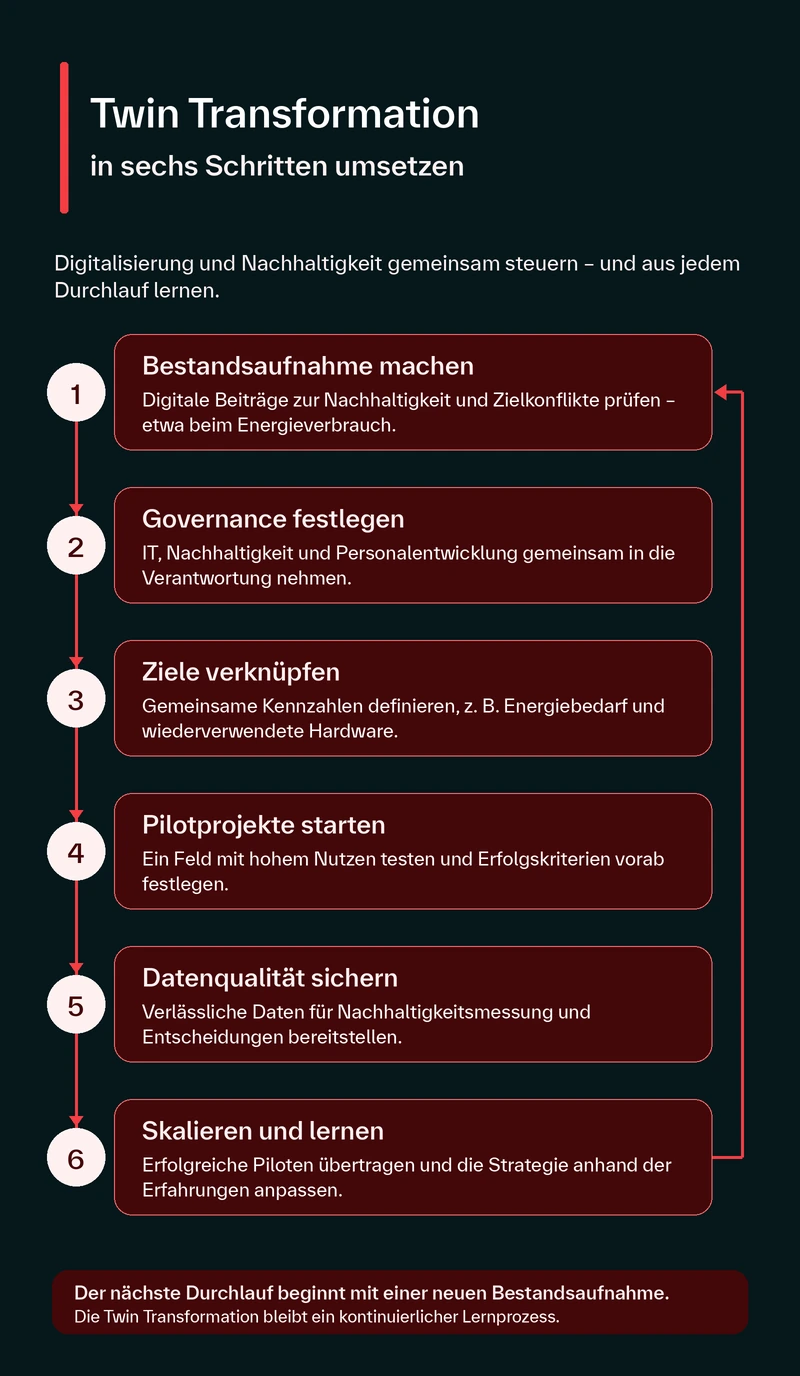
- Take stock: Analyze where digital processes are already contributing to sustainability and where there are conflicting goals—for example, due to the high energy consumption of new systems.
- Establish governance: Define clear responsibilities that bring together IT, sustainability, and human resources development, rather than keeping these areas in separate departments.
- Align Goals: Define common metrics that link digital and sustainability goals, such as the energy consumption of digital processes or the percentage of recycled or reused hardware.
- Launch pilot projects: Choose an application area that offers high value and manageable risk, such as energy efficiency or supply chain transparency. Launch an initial test run in that area with clearly defined success criteria.
- Ensuring Data Quality: Make sure you have a clean database early on, because reliable data is the foundation of every sustainability measurement and every governance decision.
- Scale and learn: Apply successful pilot projects to other areas and continuously adapt your strategy based on the experience you’ve gained.
It is important to understand all six steps as a cycle: After scaling, the next cycle begins with a new assessment, so the Twin Transformation is never truly complete but continues to evolve.
What skills are needed for the Twin Transformation?
Technology and strategy alone are not enough: The Twin Transformation can only succeed with the right skills within the team. These include, in particular:
- digital skills, such as data literacy and the confident use of AI tools
- Sustainability Skills, such as life-cycle thinking and the proper use of relevant key performance indicators
- Systems Thinkingto identify interactions between digitalization and sustainability
- Ability to collaborate, to strengthen collaboration between IT, sustainability, and human resources development
Human resources development can specifically foster these skills by providing joint training for employees from different departments. This not only fosters greater mutual understanding but also establishes a shared vocabulary for the Twin Transformation.
Change management plays a central role in this process: Leaders should involve employees early on, communicate openly about conflicting goals, and foster a culture of learning in which continuous upskilling in digitalization and sustainability is a natural part of everyday work.
Measuring Progress and Reviewing Twin Transformation Projects
Without the right metrics, progress in the Twin Transformation remains invisible. Meaningful indicators link environmental impact to the digital footprint and can be aligned with clear goals:
It is important to collect these metrics regularly, make them visible for governance decisions, and link them to the company’s other sustainability goals, rather than viewing them in isolation. It is equally important to consider economic viability: Only projects that are financially viable in the long term can be scaled across the entire company.
For new digital projects, it’s also worth conducting a brief practical review before implementation begins, because not every project that makes technical sense or is economically attractive automatically contributes to sustainability:
- Does the project make a measurable contribution to a sustainability goal?
- Have the energy and resource requirements been assessed over the entire life cycle?
- Have responsibilities for governance and data quality been clarified?
- Were potential rebound effects taken into account, and were countermeasures implemented where necessary?
- Does the team already have the necessary skills, or have they been specifically planned for?
- Can progress be demonstrated using clear metrics?
Shaping the Twin Transformation Together with the Haufe Akademie
The Twin Transformation is not a project that can be completed overnight. Companies are continuously driving this development forward on their own. With the right support, this challenge becomes a real opportunity for growth, new capabilities, and a clear competitive advantage across the entire organization.
Content Collection , a division of the Haufe Akademie , provides flexible learning content on the topic of sustainability that can be integrated into your existing digital transformation initiatives. For decades, we have been supporting companies through precisely these kinds of change processes, bringing reliability and practical expertise to the table. Together with you, we develop learning paths so that digitalization and sustainability truly converge, rather than running parallel to one another. In this way, the Twin Transformation becomes not a cost factor, but a lever for sustainable growth that pays off both ecologically and economically.
Discover the " Content Collection " now
FAQ
What does “Twin Transformation” mean?
"Twin Transformation" describes the integrated management of digitalization and sustainability within companies. Instead of addressing these two topics separately, companies combine their digital and sustainability goals into a single strategy, thereby leveraging synergies rather than creating conflicting objectives. This applies to both a company’s technology and human resources strategies.
What is the difference between Green IT and sustainable digitalization?
Green IT, also known as Sustainable IT, focuses on IT operations themselves, such as energy-efficient data centers and hardware. Sustainable digitalization goes a step further and examines how digital technologies as a whole contribute to a company’s sustainability goals. Twin Transformation brings these two perspectives together as a unified corporate strategy and embeds them within the organization.
Is digitalization automatically sustainable?
No. Digital solutions themselves consume energy and raw materials, and rebound effects can even lead to increased rather than decreased resource consumption. Digitalization only becomes sustainable when companies actively consider energy, material, and life-cycle aspects from the very beginning, rather than correcting them after the fact. This is precisely what the Twin Transformation achieves as a guiding framework.
What skills do employees and managers need for the Twin Transformation?
Employees and managers need both digital and sustainability-related skills—such as data literacy, life-cycle thinking, and an understanding of systems—as well as the ability to collaborate across departmental boundaries. Change management and an open learning culture help to embed these competencies throughout the company and continuously develop them further.
You might also be interested in


