
Online Training for Businesses: Choosing and Implementing the Right E-Learning Solutions


E-learning stands out for one thing above all else: content reaches employees at exactly the right moment. Online training for businesses is most effective when the content, target audience, and learning environment align. In this article, learn when high-quality online training makes sense for businesses and when modular “learning nuggets” offer more flexibility. Choosing the right format is key to acceptance and learning success. Here’s how to find the right balance between standardization and customization for your workforce development.
Online Training for Businesses: Key Points at a Glance
- Online training programs for businesses combine digital learning formats and complement—rather than replace—the traditional mix of in-person training and seminars.
- Comprehensive e-learning courses are ideal for broad-based skill development, while modular learning nuggets are suited for individualized, role-specific learning paths.
- When making a selection, quality, integration with a learning platform, and the appropriate licensing model are key factors in determining long-term value.
- " Content Collection " covers a broad range of skill development, while " Content Kit " enables personalized learning paths; both approaches can be combined.
- A phased rollout with a clear need, technical integration, and visible support from management is key to success.
What sets online training courses for businesses apart?
Online training programs for businesses bring together digital learning resources that enable employees to develop new skills from anywhere. E-learning for businesses takes many different forms, ranging from e-learning courses and short “learning nuggets” to interactive live online training sessions.
It is crucial to clearly distinguish between three levels:
- the course content
- the learning format and
- the platform through which you provide the content.
Only by distinguishing between these levels can you ultimately choose the right digital employee training program. In this way, online training for businesses complements—rather than replaces—the traditional mix of in-person training and seminars.

Typical areas of application range from leadership skills, project management methods, and presentation techniques to soft skills and industry-specific expertise. Different formats are suitable depending on the topic: standard knowledge is best conveyed through broad-based training, while specialized knowledge benefits from shorter, targeted sessions. Basic knowledge of AI is now also among the most sought-after topics for corporate online training.
For more background on the introduction and formats, see our article on digital learning in the workplace.
What are the differences between online training, e-learning, and live online training?
These three terms are often used interchangeably, but they mean different things.
- "Online training " generally refers to any digital learning format.
- E-learning refers specifically to structured courses or learning nuggets that employees can complete on their own and at their own pace.
- Live online training, on the other hand, takes place at a set time, such as in a virtual classroom at trainers.
Why do companies use online training?
Online training courses offer far more than just basic knowledge. When used correctly, they cover four key areas of application. The relative importance of these areas varies depending on the size of the company and the maturity level of its human resources development:
- comprehensive skills development for many employees at the same time,
- Role- and target-group-specific learning paths for individual teams,
- Refresh your knowledge in your day-to-day work and apply it right away,
- Combine digital content with in-person or live online formats to create a blended learning approach.
It is precisely this combination of scalable foundational learning and targeted learning at the “moment of need” that makes online training so effective for employees. As a result, online training becomes a powerful tool for companies to build skills sustainably. AI is increasingly helping to automatically suggest relevant content and tailor learning paths to individual needs.
Ready-made e-learning courses or modular learning nuggets?
The key decision for any e-learning strategy is choosing between two approaches.
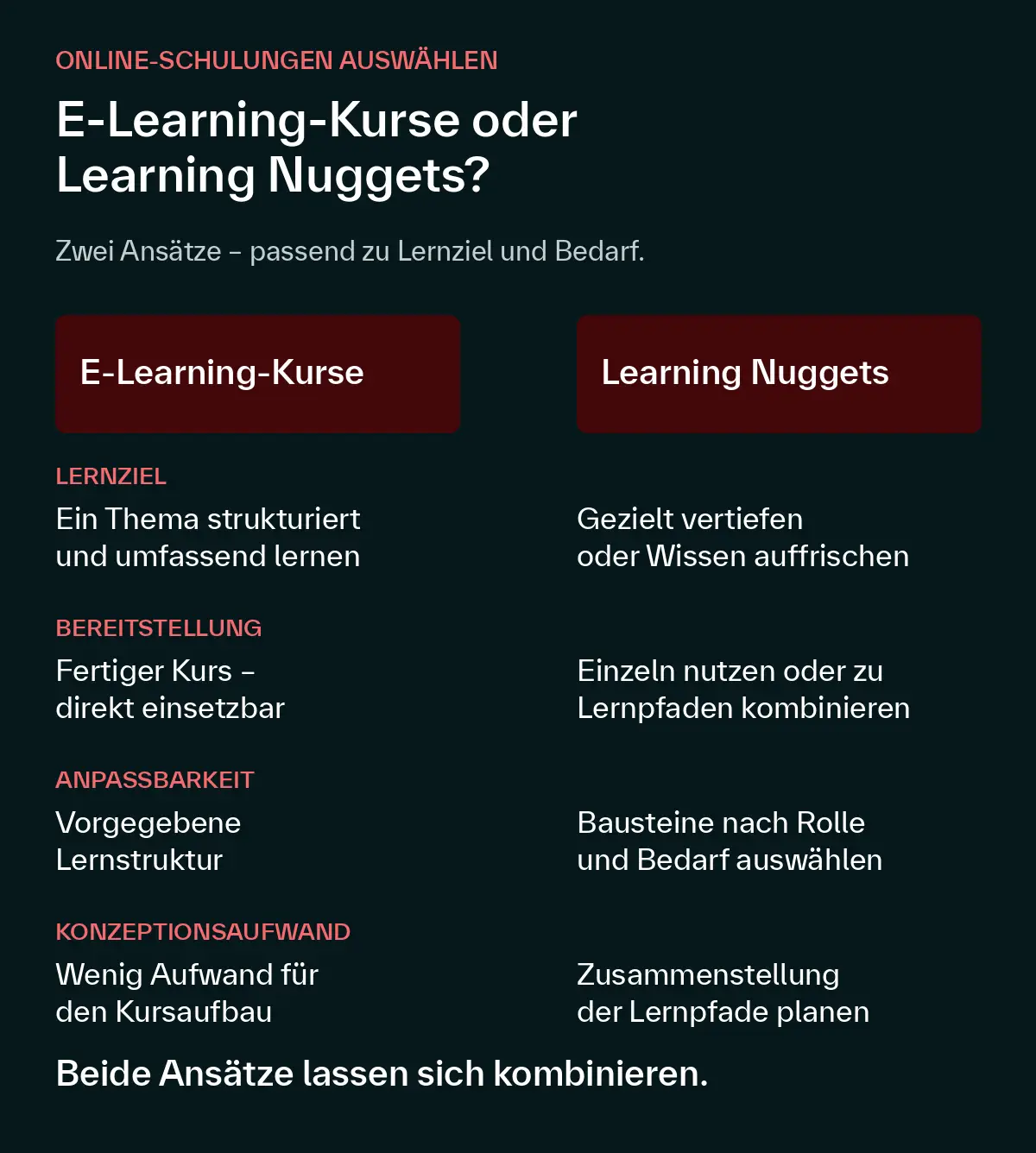
- Complete online courses are ready to use right away and cover a topic in a structured way from start to finish.
- Learning Nuggets are short, self-contained learning modules that can be flexibly combined to create individual learning paths and learning journeys.
A project management course on Scrum is a typical example of a comprehensive e-learning course, while a 2-minute microlearning nugget on a new tool feature is a typical example of a learning nugget.
Both approaches have clear strengths. Comprehensive courses save time and effort in course design and quickly reach a large number of employees. Microlearning nuggets and the learning paths created with them, on the other hand, adapt well to specific roles, prior knowledge, and current needs, and can be recombined at any time.
Decision Matrix: Which Approach Fits Which Need?
The following overview summarizes when each approach is appropriate:
Which online training courses are right for your company?
Relevance, quality, and practical applicability in everyday work determine which online training courses are truly the right fit for your company. Before you decide on a provider’s course offerings or purchase e-learning content, it’s therefore worth considering the following criteria:
- Clearly define learning objectives and target audiences in advance
- Review the academic quality, pedagogical approach, and relevance of the content
- Align topics, languages, and learning formats with needs
- Clarify integration with LMS or LXP early on, for example, using standards such as SCORM, CMI5, LTI 1.3, or OCN (technical standards for data exchange between learning content and platforms)
- Compare e-learning providers' licensing models, maintenance requirements, and support services for businesses
- Consider AI-powered recommendation systems and learning analytics as additional quality indicators
If you'd like to bundle multiple providers, you'll find additional criteria for a curated selection in our article on e-learning aggregation.
How Much Do Online Training Courses Cost for Businesses? An Overview of Licensing Models
The cost of online training for businesses depends heavily on the model chosen. The key factors are the number of users, the scope of the content, the effort required to integrate the training into existing systems, and the contract term.
In practice, the following licensing models have become established:
- Named-User License: You pay per registered user. This solution is ideal for building broad expertise through an e-learning library such as Content Collection.
- Modular License: You pay based on the actual use of individual Learning Nuggets. For example, you can put together a bundle of 100 Learning Nuggets on the topic of leadership and roll it out to as many users as you like. This model is well-suited for custom learning paths, such as those found in Content Kit.
- Single-Course License: You purchase individual courses as needed. This option is ideal for very specific, one-time needs.
In addition to the license fee, internal costs associated with selecting, integrating, and maintaining the content are factored into the total cost. A consultation with the provider usually provides the most reliable estimate, as prices vary depending on the size of the company and the desired range of features.
Two Ways to Find the Right Digital Learning Content for Online Training in Your Company
Once you've identified your needs, there are two ways to find the right digital learning content for your company.
Content Collection: Ready-made e-learning courses for broad-based skill development
With this Content Collection you can reach your entire workforce with courses on personal and cross-functional skills without having to produce your own content. The range of topics extends from leadership and communication to self-organization and digital skills, allowing you to reach different target groups with a single solution. The courses are curated and are constantly expanding. You can deliver them directly through your existing learning platform.
New topics are continuously developed by the subject matter experts at the German Society for the Study of the Brain ( Haufe Akademie ) and made available to the German Neuropsychology Society ( customers ) on Content Collection .
Content Kit: Learning Nuggets for Individual Learning Paths and Learning Journeys
With the Content Kit you can create customized learning paths on your own and supplement existing programs with microlearning for businesses. This allows you to create learning paths and learning journeys that are precisely tailored to a role and level of experience, and to design digital learning pathways that continuously adapt to new requirements. A typical use case: New managers receive targeted learning nuggets on feedback and delegation during their first few weeks, rather than having to work through an entire course. Knowledge is thus available as performance support exactly when employees need it in their day-to-day work.
Combine both approaches
E-learning courses and modular learning nuggets are not mutually exclusive. E-learning courses provide a broad foundation of basic knowledge. Learning nuggets then supplement the e-learning courses in advanced learning paths, refresh knowledge, and support ongoing programs in day-to-day work.
Here’s an example: A comprehensive introductory course on “Using AI in Everyday Work” provides consistent training for all employees, while supplementary Learning Nuggets then delve deeper into role-specific scenarios. For complex leadership topics, Learning Nuggets can be supplemented with in-person seminars to facilitate direct dialogue. Assess on a case-by-case basis where both approaches complement each other effectively and where, if appropriate, in-person formats might also be beneficial.


Implementing Online Training in 7 Steps
A well-planned introduction is key to acceptance and learning success. These steps have proven effective in practice:
- Identify competency and business needs: Analyze which competency gaps are currently hindering business goals and where the greatest leverage lies.
- Prioritize target audiences and usage scenarios: Determine which roles should start first and in which work situations they should learn.
- Selecting Learning Objectives and Appropriate Content Formats: Define measurable learning objectives and decide whether full courses or learning nuggets are a better fit.
- Set up the technical infrastructure and interfaces. Technically integrate the content with your LMS or LXP and ensure that usage data and progress are tracked correctly.
- Start with a realistic use case: Test the concept within a team or department first, rather than rolling it out company-wide right away.
- Actively support communication, learning time, and knowledge transfer: Inform employees early on, set aside dedicated time for learning, and provide guidance on how to apply what they’ve learned in their day-to-day work.
- Regularly evaluate usage and impact: Analyze usage data and feedback, and continuously adjust your portfolio.
Key Factors for Effective Online Training
The effectiveness of a digital employee training program comes down to the details. These factors significantly increase the chances of success:
- clear relevance to one's role and day-to-day work
- Manageable learning units with clear learning objectives
- Freedom of choice where it makes sense
- Transfer Exercises, Practice Problems, and Feedback
- visible support from managers
- Regular maintenance of the entire portfolio
- Using AI-powered learning analytics to continuously measure success
Haufe Akademie: Online training courses that grow with your business
Whether it’s broad-based skill development or personalized learning paths, Haufe Akademie supports your workforce development with both paths to success. The Content Collection provides ready-to-use, curated e-learning courses for companies, making skills development immediately scalable. This Content Kit complements this broad framework with flexible “learning nuggets” that can be used to create personalized learning paths for different roles, teams, and current needs.
Both products grow with your company and can be combined at any time. As a long-standing partner in workforce development, we’ll work with you to find the right starting point and continue to develop our e-learning library in close collaboration with you, with the goal of ensuring that your investment in professional development yields measurable results.
Discover " Content Collection " now →
Start using " Content Kit " now →
FAQ
What are online training courses for businesses?
Online training for businesses encompasses all digital learning formats that companies use to provide continuing education to their employees, regardless of time or location. These include comprehensive e-learning courses, learning nuggets, and live digital sessions with trainers.
Does a company need a LMS for online training?
Learning Management System (LMS) is a worthwhile investment as soon as you want to centrally manage and evaluate multiple formats. For those just getting started, a streamlined learning platform with an interface to existing systems is often sufficient.
What is the difference between e-learning courses and learning nuggets?
Complete e-learning courses cover a topic in a structured and comprehensive manner. Learning Nuggets are shorter, self-contained units that can be flexibly combined to create personalized learning paths.
How do companies choose the right provider?
Key factors include the quality of the subject matter, the timeliness of the content, the available languages and formats, and technical integration into the existing learning environment. The licensing model and maintenance requirements should also be included on the checklist.
You might also be interested in


