4.5
4.5
Open Badges
Add your digital badge to career networks and show what you can do.
Introduction to occupational health management (OHM)
Setting priorities and levers
Mandate, roles, steering committee
Core strategies and overall process
Use of AI in health management
Note: The use of AI is explained using examples and at a basic level. Detailed technical training is not part of the seminar.
In your online learning environment, you will find useful information, downloads and extra services for this training course once you have registered.
You will be actively involved in discussions and group work and can work on your own questions. Using many practical examples, we will also think through and discuss how to deal with resistance and problems in a solution-oriented way. Case studies can and should be brought in and discussed.
Employees, specialists and managers who want to gain qualifications in occupational health management. This training is recommended for all departments. Also suitable for works council members.

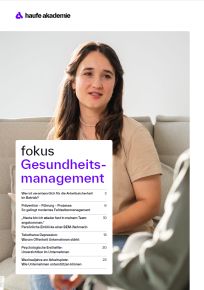
News and useful information on workplace health management, workplace disability management, mental health, and occupational safety in companies.


Tuesday, 03.11.2026
09:30 am - 5:00 pm
Wednesday, 04.11.2026
09:00 am - 4:00 pm
Tuesday, 12.01.2027
09:30 am - 5:00 pm
Wednesday, 13.01.2027
09:00 am - 4:00 pm
Thursday, April 8, 2027
09:30 am - 5:00 pm
Friday, April 9, 2027
09:00 am - 4:00 pm
Monday, July 19, 2027
09:30 am - 5:00 pm
Tuesday, July 20, 2027
09:00 am - 4:00 pm
Training is guaranteed to take placeYour optimizer, innovator and companion since 1978 -
Your professional partner for professional development and seminars, training courses and topical conferences.
Whether on site, live online or in-house - our customised solutions, our claim to the highest level of consulting expertise and training tailored to your needs simplify the acquisition of skills for the working world of the future and sustainably facilitate professional development.
A wide range of seminars, individual coaching and our flexible formats support HR managers and decision-makers in shaping the future and developing employees, in-house teams and companies.
Experience the benefits of online training from the comfort of your own home. Our online formats meet the highest quality standards and are in no way inferior to face-to-face events in terms of practical relevance. Learn together live online in interactive groups or digitally at a time of your choice.
We are there for you Monday to Friday 8:00 a.m. - 5:00 p.m.
In our Questions & Answers (FAQ) section, you will find all the answers and the most frequently asked questions about your selected topic.