Accounting for travel expenses correctly
The current law on travel and entertainment expenses
 4.6
4.6
Contents
Legal basis
- Income Tax Act.
- Wage tax guidelines.
- BMF letter.
Travel expense law with current tax accounting rates
- Work-related external activity vs. first place of work.
- Necessary options for the employer under labor and employment law.
- Private business trip extension, mixed travel, BahnCard regulation, job ticket, credit card use.
- Calculation examples for domestic and foreign invoices (incl. current tables).
Additional meal expenses
- Application of flat rates at home and abroad, including aggregation and midnight rule.
- 3-month period.
- Permissible lump-sum taxation.
- The provision of meals (incl. breakfast for overnight stays) according to EStG and BMF letter, in particular reduction of the meals allowance vs. remuneration in kind.
Reimbursement of travel expenses
- When working away from home.
- By private car, by public transportation.
Accommodation costs
- Domestic.
- Abroad.
Incidental travel expenses
- Fees.
- Insurances.
Certification obligations of the employer
- Document management.
- Retention and reporting obligations.
Basics of dual budgeting
- Prerequisites.
- Differentiation from travel expense reimbursements.
- Maximum amount limit.
Learning environment
In your online learning environment, you will find useful information, downloads and extra services for this training course once you have registered.
Your benefit
The:die trainer shows you in a practical way how to check the requirements for travel expense reimbursement, how to claim correctly and thus avoid complaints from the tax office:
- The individual issues are illustrated using numerous practical examples of domestic and foreign settlements discussed in plenary sessions.
- You will receive up-to-date information on rulings, wage tax and social security law peculiarities, payroll rates and benefits in kind.
- You will also benefit from many tips and structuring options that allow you to take advantage of tax benefits.
Methods
Specific case studies, practical cases, exercises and discussions deepen the knowledge imparted in the lecture. Laws, current rulings and BMF letters as well as individual questions on individual topics are dealt with in the training .
Recommended for
employees in the travel expense center and/or financial accounting department, secretarial staff and employees in the HR department who prepare travel expense reports, as well as HR and financial accounting managers who are responsible for travel expense reports, among other things. However, this training is also suitable for re-entrants as a refresher.



Questions about the seminar content
In training how to systematically review travel expenses, categorize them correctly, and settle them accurately. This is especially helpful if you regularly review receipts, flat-rate allowances, travel expenses, or lodging costs and want to avoid having errors flagged by the tax office later on.
You'll receive up-to-date information on court rulings, specific provisions regarding income tax and social security law, payroll rates, and non-cash benefits. This will help you better understand new developments and verify that your existing processes are up to date.
You’ll gain clarity on the distinction between work performed outside the office and the primary place of work. This will help you in your day-to-day work to handle reimbursements correctly and explain to employees in a clear and understandable way why certain expenses can or cannot be reimbursed tax-free.
Because there are many details to consider here—such as domestic and international flat rates, the midnight rule, aggregation, the three-month period, and meal provisions. This training uses real-world examples training you how to correctly assess these situations and avoid billing errors.
You'll learn how to classify business-and-leisure trips and personal extensions for tax purposes. This will enable you to clearly separate expenses, prepare reimbursements in compliance with tax laws, and confidently answer internal inquiries.
This training you which rules apply to business travel and how to correctly calculate travel expense reimbursements. This will enable you to accurately verify receipts, mileage, and reimbursement amounts.
This is because the way the bill is processed can vary depending on the destination, the supporting documentation, and the meals included. During training , you training evaluating such cases in a realistic setting and avoiding common mistakes on hotel bills.
You'll learn the difference between reducing meal allowances and treating them as non-cash compensation. This will enable you to correctly classify meals on hotel bills, entertainment expenses, or meals provided by your employer for tax purposes.
This training you which supporting documents are important and how to organize your paperwork in a way that meets audit requirements. This will enable you to document travel expense reports in a transparent manner and resolve any subsequent inquiries more quickly.
Because travel expenses and maintaining two households are often confused in practice. This training you better understand the requirements, distinctions, and maximum limits so that you can correctly classify cases under the appropriate tax treatment.
8790
- Customized training courses
- Direct application in practice
- Efficient use of time and resources
Further recommendations for "Accounting for travel expenses correctly"
Ratings and feedback from our participants

Start dates and details






Thursday, 27.08.2026
09:00 am - 4:30 pm
- one joint lunch per full seminar day,
- Catering during breaks and
- extensive working documents.






Monday, 14.09.2026
09:00 am - 4:30 pm
- one joint lunch per full seminar day,
- Catering during breaks and
- extensive working documents.

Tuesday, 29.09.2026
09:00 am - 4:30 pm
Tuesday, 20.10.2026
09:00 am - 4:30 pm






Monday, 02.11.2026
09:00 am - 4:30 pm
- one joint lunch per full seminar day,
- Catering during breaks and
- extensive working documents.
Tuesday, 03.11.2026
09:00 am - 4:30 pm
Tuesday, 09.02.2027
09:00 am - 4:30 pm

Wednesday, 03.03.2027
09:00 am - 4:30 pm
- one joint lunch per full seminar day,
- Catering during breaks and
- extensive working documents.
Thursday, 11.03.2027
09:00 am - 4:30 pm




Tuesday, 27.04.2027
09:00 am - 4:30 pm
- one joint lunch per full seminar day,
- Catering during breaks and
- extensive working documents.
Monday, May 31, 2027
09:00 am - 4:30 pm
Thursday, June 17, 2027
09:00 am - 4:30 pm
Thursday, July 1, 2027
09:00 am - 4:30 pm
Thursday, September 2, 2027
09:00 am - 4:30 pm
Training is guaranteed to take place- one joint lunch per full seminar day,
- Catering during breaks and
- extensive working documents.
You might also be interested in:
About us - The Haufe Akademie
Your optimizer, innovator and companion since 1978 -
Your professional partner for professional development and seminars, training courses and topical conferences.
Whether on site, live online or in-house - our customised solutions, our claim to the highest level of consulting expertise and training tailored to your needs simplify the acquisition of skills for the working world of the future and sustainably facilitate professional development.
A wide range of seminars, individual coaching and our flexible formats support HR managers and decision-makers in shaping the future and developing employees, in-house teams and companies.
Experience the benefits of online training from the comfort of your own home. Our online formats meet the highest quality standards and are in no way inferior to face-to-face events in terms of practical relevance. Learn together live online in interactive groups or digitally at a time of your choice.
Do you have any questions?
We are there for you Monday to Friday 8:00 a.m. - 5:00 p.m.

Questions & Answers
In our Questions & Answers (FAQ) section, you will find all the answers and the most frequently asked questions about your selected topic.

Munzinger Str. 9
79111 Freiburg

- Planning security
- Free seminar places
- Quality standards
- Planning and locations
- Funding opportunities
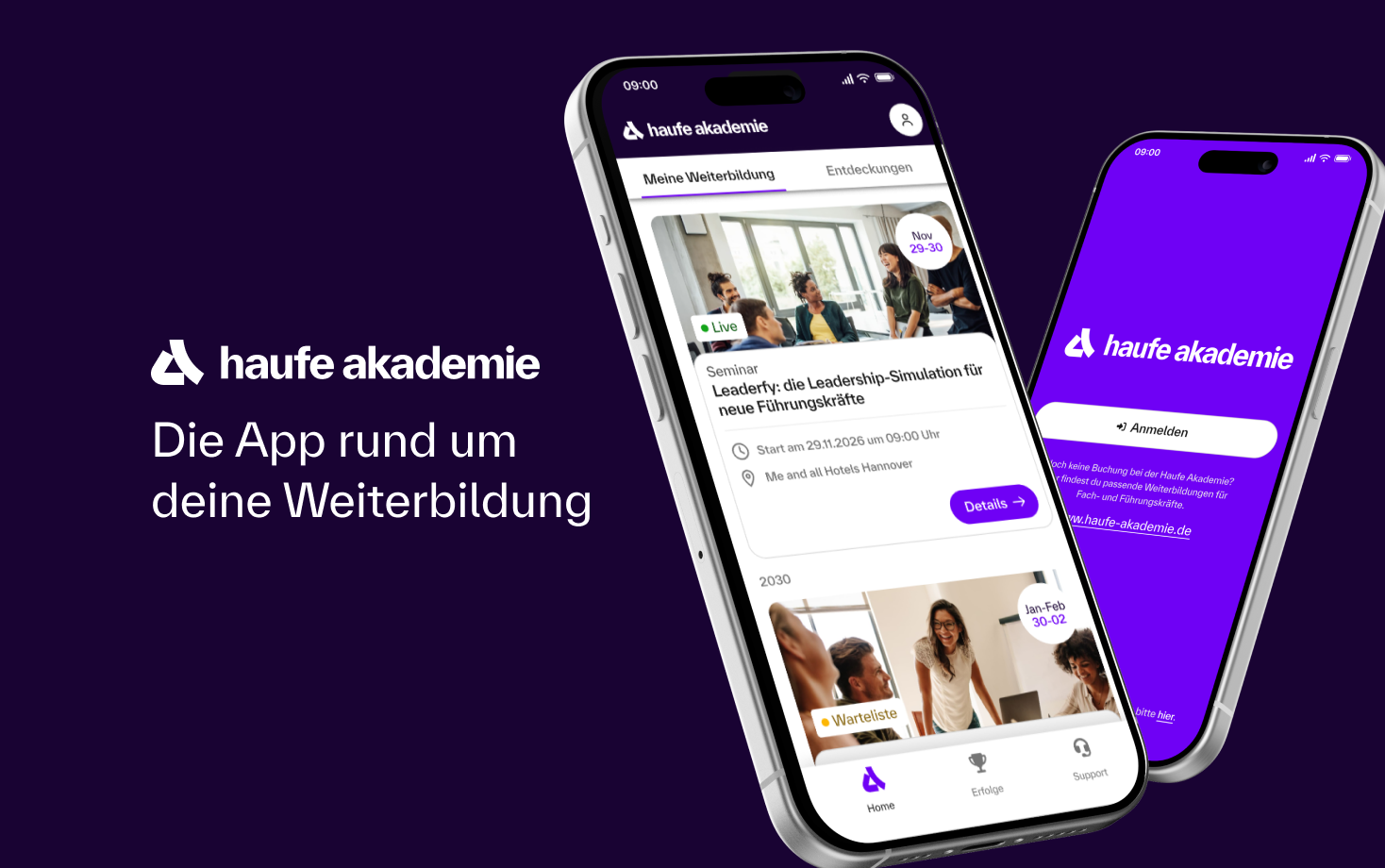
- Training app
- Business Solutions


