With certificate
Upon successful completion, you will receive a recognized certificate that documents your newly acquired skills.
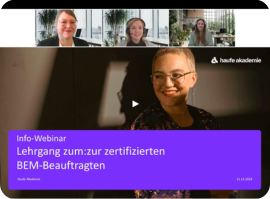
BEM expert and trainer Karolin Schilp as well as Dr. Stefanie Schüler-Hammer and Isabell Uetz from the Haufe Akademie team will be happy to give you a detailed introduction to the course to become a certified BEM representative.
Those responsible for/participating in company integration management (BEM) as well as BEM officers, HR managers, experienced specialists and managers with a supervisory function, works council members and representatives of severely disabled persons, company and works doctors and other interest groups.
Exam prerequisite:
Exam form: In addition to technical knowledge, the exam tests the extent to which you are able to apply what you have learned in practice. The focus here is on transfer.
Examination contents:
We recommend the following sequence:
Participation in compulsory seminar 1
Exam part 1: E-exam (relates to the content of compulsory seminar 1). Important: To be able to take the exam, you must have already booked the exam module and booked a date for exam part 2.
Participation in compulsory seminar 2
Participation in compulsory seminar 3
Exam part 2: Presentation of a case study via Zoom
We recommend attending the modules within a maximum of two years.
No, it is an "open course", i.e. the seminars include both course participants and people who only attend one of the seminars, for example. This ensures maximum flexibility so that every can decide for themselves whether to attend the entire course or just individual seminars.
The seminars build on each other in terms of content and are coordinated. While the first module deals in particular with the basics of BEM under employment law, the focus of modules 2 and 3 is on getting to know the BEM process in detail and learning how to apply it. The focus here is on discussion skills. Therefore, please attend the compulsory seminars in the suggested order.
It is recommended that you have already had initial contact with the topic of BEM in your professional environment and have some practical experience so that you can contribute and discuss your own practical examples in the individual seminars. Practical knowledge is also an advantage when preparing the case study for the final examination.
Registration & tool: You complete the 1:1 coaching after the 3rd compulsory seminar (advanced training in company integration management) and before the second part of the exam. Dr. Stöpel and Ms. Schilp are available to you as experts . You can arrange the date yourself with Dr. Stöpel or Ms. Schilp. You are welcome to contact Dr. Stöpel or Ms. Schilp directly during a seminar break and make an appointment. Alternatively, you can find their contact details in your learning environment in the document "Information on transfer coaching". The coaching itself takes place as a video call via MS Teams.
The exam consists of two parts:
1. 30-minute e-exam (multiple choice) on the labor law content from Module 1
2. preparation and presentation of an own case study (10-15 min. presentation and subsequent discussion in plenary with the examiners and other course participants).
Note: You can find detailed information about the exam here or after registering for the course in your learning environment.
If you are ill, you can withdraw from the exam in justified exceptional cases and register for a new date. If you do not pass one of the parts of the exam, you can of course retake it. In this case, the examination fee must be paid again. You do not need to repeat the part of the exam that you have passed.
After completing the course and passing the exam, you will be a certified representative with a Haufe Akademie.
Travel at reduced rates by booking via the learning environment.

Interesting facts about BEM: Our experts shed light on various aspects of BEM for you. Have fun reading!

Your optimizer, innovator and companion since 1978 -
Your professional partner for professional development and seminars, training courses and topical conferences.
Whether on site, live online or in-house - our customised solutions, our claim to the highest level of consulting expertise and training tailored to your needs simplify the acquisition of skills for the working world of the future and sustainably facilitate professional development.
A wide range of seminars, individual coaching and our flexible formats support HR managers and decision-makers in shaping the future and developing employees, in-house teams and companies.
Experience the benefits of online training from the comfort of your own home. Our online formats meet the highest quality standards and are in no way inferior to face-to-face events in terms of practical relevance. Learn together live online in interactive groups or digitally at a time of your choice.
We are there for you Monday to Friday 8:00 a.m. - 5:00 p.m.
In our Questions & Answers (FAQ) section, you will find all the answers and the most frequently asked questions about your selected topic.