4.6
Open Badges
Add your digital badge to career networks and show what you can do.

The basics of creativity
Search for ideas
Selection of ideas
Realization of ideas
Ideas Workshop
In your online learning environment, you will find useful information, downloads and extra services for this training course once you have registered.
Varied and interactive, training with workshop character. New ideas are generated and evaluated using creativity and innovation techniques based on specific questions from different areas.
Employees in all functions who constantly need new or unconventional ideas and input for their work. In particular, specialists and managers from the areas of marketing, product management, communication, advertising and sales are addressed.


Wednesday, 03.03.2027
09:00 am - 5:00 pm
Thursday, 04.03.2027
09:00 am - 4:00 pm

Thursday, June 3, 2027
09:00 am - 5:00 pm
Friday, June 4, 2027
09:00 am - 4:00 pm
Monday, September 20, 2027
09:00 am - 5:00 pm
Tuesday, September 21, 2027
09:00 am - 4:00 pm
The next booking ensures this course will take placeYou’ll learn to systematically develop ideas for products, services, and marketing campaigns instead of relying on chance: identifying barriers to creativity, refining questions, using methods such as brainwriting or Lego Serious Play to generate ideas, evaluating them, and turning them into an initial action plan. You’ll also learn how to facilitate your own idea workshop.
The " training " is structured as a workshop. You'll spend two days working on specific issues and trying out each method for yourself.
Yes. In sales, you need new approaches to win over customers ; in advertising, campaigns need to stand out. With creativity techniques, you can develop such ideas in a structured way, rather than waiting for that one flash of inspiration. No prior knowledge is required.
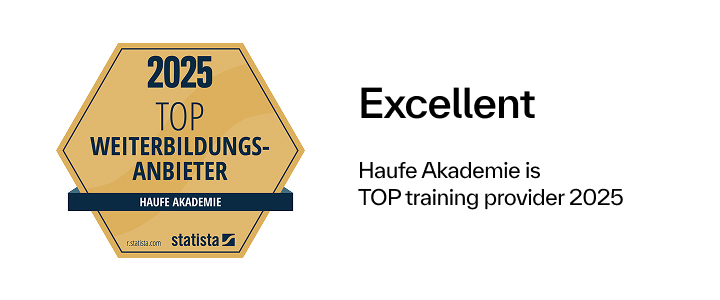
Participants rate the " training " 4.6 out of 5 stars (based on over 330 reviews).
The " training " lasts two days. It takes place in person or live online via Zoom. The fee includes course materials, lunch, and snacks during breaks for in-person sessions. You can find the current dates, locations, and prices on the seminar page.
You can add a two-hour transfer coaching session with the expert at a discounted rate when you book it at the same time. For companies, “ training ” is available as an in-house training program, such as an ideas workshop for an entire team. To deepen your knowledge, check out the continuing education courses “ certified innovation manager ” (5627) and “Kreativ mit KI: So entstehen bessere Ideen mit ChatGPT & Co.” (42076). Upon completion, you’ll receive an Open Badge.
Language models generate answers based on patterns in existing texts. That’s why they’re good at providing obvious ideas, but rarely surprising ones. Furthermore, they don’t know your company, your customers , or your capabilities. AI is useful for refining questions, exploring different ideas, or accelerating creative processes.
In the " training ," you'll explore how to use AI as a partner to enhance your own idea generation.
Typical barriers include fear of judgment, groupthink, time pressure, entrenched ways of thinking, and the expectation that ideas must be perfect right away. It can help to strictly separate the collection of ideas from their evaluation, to first collect ideas in writing and anonymously, and to consciously introduce unconventional input from outside sources.
In the " training ," you'll experience these barriers firsthand through exercises and learn to see creativity as a process you can control.
Here is a selection of the methods you'll use in " training ":
Brainwriting: A Method for Generating Ideas in Groups Without Influencing One Another
Random Input and Bisoziation to Force New Connections Using Foreign Concepts
Morphological Matrix and Osborn Checklist for Systematically Varying Solutions
Customer Value Matrix for Aligning Ideas with Customer Value
Concept extraction to apply principles from other industries
Mind mapping and Lego Serious Play to make thoughts visible and tangible
In the " training ," you apply each method to a specific problem. That way, you'll know which one to choose for which type of problem.
First, define criteria such as customer value, feasibility, costs, and alignment with strategy. Then, narrow down the ideas and evaluate the remaining ones in more detail. Edward de Bono’s Six Thinking Hats® method helps you examine an idea sequentially from analytical, critical, optimistic, emotional, creative, and process-oriented perspectives, rather than having each person simply advocate for their favorite viewpoint.
In the " training ," you'll use these techniques to select ideas from your own pool and test them with AI for an initial evaluation.
An idea profile is a brief, one-page description of an idea: the core idea, target audience, and benefits; initial thoughts on implementation; open questions; and next steps. This allows others to understand, evaluate, and further develop the idea, even when you’re not in the room.
In the " training ," you'll create profiles for your ideas and receive a template that you can use for future workshops.
First, define exactly what you want to create and for whom. Then outline the next three to five steps, including who is responsible, deadlines, and the resources you’ll need. Plan an early test to see if the idea works with minimal effort. Also, consider who you’ll need to convince within your organization.
In the " training ," you'll develop such a plan based on your own initial idea and practice presenting the idea internally.
Start by formulating a clear question and invite the right people—including those with an outside perspective. Plan the process in phases: introduction, gathering ideas, refining ideas, selection, and next steps. Choose appropriate methods for each phase and strictly separate the idea-gathering and evaluation phases. As the facilitator, make sure everyone has a chance to speak and that nothing is rejected prematurely.
In the " training ," you'll prepare an internal ideas workshop and learn how to conduct it digitally using Miro.
Your optimizer, innovator and companion since 1978 -
Your professional partner for professional development and seminars, training courses and topical conferences.
Whether on site, live online or in-house - our customised solutions, our claim to the highest level of consulting expertise and training tailored to your needs simplify the acquisition of skills for the working world of the future and sustainably facilitate professional development.
A wide range of seminars, individual coaching and our flexible formats support HR managers and decision-makers in shaping the future and developing employees, in-house teams and companies.
Experience the benefits of online training from the comfort of your own home. Our online formats meet the highest quality standards and are in no way inferior to face-to-face events in terms of practical relevance. Learn together live online in interactive groups or digitally at a time of your choice.
We are there for you Monday to Friday 8:00 a.m. - 5:00 p.m.
In our Questions & Answers (FAQ) section, you will find all the answers and the most frequently asked questions about your selected topic.