Successful cooperation with international business partners
Basics of intercultural competence
 4.7
4.7
Contents
Fundamentals and importance of culture in international cooperation
- What is culture? - Definition and relevance in an international context.
- Influence of cultural differences on cooperation and communication.
- Cultural misunderstandings and their causes.
- Perception, prejudices and dealing with stereotypes.
Understanding and classifying cultural differences
- Introduction to central cultural dimensions (e.g. Hofstede, Hall).
- Practical exercises: attendees select cultures, these are compared with each other and practical options for action are derived from them.
Effective communication with international partners and conflict resolution
- Dealing with different communication styles.
- Comprehensible and clear business English.
- Recognize intercultural conflict styles and react appropriately.
- Strategies for successful intercultural conflict management.
Development of intercultural sensitivity and skills
- Different approaches to building trust in an international team.
- Dealing with common challenges in international teams.
- Promote intercultural motivation and cooperation.
- Strategies for developing and expanding intercultural competence.
Learning environment
In your online learning environment, you will find useful information, downloads and extra services for this training course once you have registered.
Your benefit
- Examination of the cultural origin and personal imprint.
- Awareness of the impact of cultural differences on cooperation and working relationships.
- Appreciation of cultural diversity and viewing it as an enrichment.
- Understanding of different cultural logics and behaviors.
- Expanding the scope of action through reflection and interpretation of work situations.
Methods
experts, moderated group discussions, individual and group work, role plays, case studies, exercises, films and discussion of issues raised by the attendees .
Recommended for
Specialists and managers who work in international teams or cooperate with international business partners and would like to develop their intercultural skills.
The training is particularly suitable for people with many target countries.
Questions about the seminar content
In international teams, direct, indirect, task-oriented, and relationship-oriented communication styles often coexist. This training will show you how to recognize these differences and tailor your own communication to make it easier to understand. The focus on unambiguous Business English, clear messages, and consciously managing room for interpretation is particularly helpful. This will enable you to structure conversations, coordination efforts, and feedback in a way that reduces friction and ensures better understanding.
Many challenges arise because one’s own behavior is perceived as normal, while other ways of working are quickly judged as unstructured, aloof, slow, or unreliable. This training helps you reflect on your own cultural background. This allows you to recognize your own expectations regarding deadlines, decisions, hierarchies, commitment, and feedback. This awareness helps you judge less automatically and instead be more flexible in dealing with other perspectives.
Depending on the cultural context, conflicts are addressed, avoided, signaled indirectly, or discussed openly in very different ways. This training will teach you how to recognize intercultural conflict styles and respond appropriately. You’ll learn not only to look at the visible conflict but also to consider possible causes, such as differing expectations regarding communication, status, time, responsibility, or decision-making processes. This will enable you to act in a way that de-escalates the situation and find solutions that are acceptable to all parties.
This training will show you how to take cultural differences seriously without reducing people to national or cultural stereotypes. You’ll explore perceptions, biases, and stereotypes and learn to interpret your observations in a more nuanced way. This is especially important when you work with many different target countries. Instead of memorizing blanket rules, you’ll develop an approach and methods that allow you to act with curiosity, respect, and in a way that’s appropriate to the situation.
When you work with many different countries, detailed knowledge of individual cultures is often not enough. You need a flexible understanding of how cultural differences fundamentally arise and how they manifest themselves in everyday work. This training provides you with the fundamentals, reflection methods, and practical strategies for dealing with these situations. Through case studies, exercises, group work, and comparisons of selected cultures, you’ll strengthen your intercultural competence.

Learning and shaping a sustainable future
Embracing diversity and including people with different views and backgrounds are future skills that you will learn in this training , among other things. According to our partner, the Inner Development Goals Initiative (IDGs), you are also contributing to a sustainable future. This is because the IDGs have scientifically and globally identified the future skills needed to achieve the United Nations Sustainable Development Goals (SDGs). What exactly does that mean? Find out more.
- Customized training courses
- Direct application in practice
- Efficient use of time and resources
Further recommendations for "Successful cooperation with international business partners"
Ratings and feedback from our participants

Start dates and details









Wednesday, 30.09.2026
09:00 am - 5:00 pm
Thursday, 01.10.2026
09:00 am - 5:00 pm
- one joint lunch per full seminar day,
- Catering during breaks and
- extensive working documents.





Monday, 30.11.2026
09:00 am - 5:00 pm
Tuesday, 01.12.2026
09:00 am - 5:00 pm
- one joint lunch per full seminar day,
- Catering during breaks and
- extensive working documents.





Wednesday, 17.02.2027
09:00 am - 5:00 pm
Thursday, 18.02.2027
09:00 am - 5:00 pm
- one joint lunch per full seminar day,
- Catering during breaks and
- extensive working documents.







Monday, May 10, 2027
09:00 am - 5:00 pm
Tuesday, May 11, 2027
09:00 am - 5:00 pm
- one joint lunch per full seminar day,
- Catering during breaks and
- extensive working documents.


Monday, October 25, 2027
09:00 am - 5:00 pm
Tuesday, October 26, 2027
09:00 am - 5:00 pm
- one joint lunch per full seminar day,
- Catering during breaks and
- extensive working documents.
Training is guaranteed to take placeThe next booking ensures this course will take place- one joint lunch per full seminar day,
- Catering during breaks and
- extensive working documents.
- one joint lunch per full seminar day,
- Catering during breaks and
- extensive working documents.
You might also be interested in:
About us - The Haufe Akademie
Your optimizer, innovator and companion since 1978 -
Your professional partner for professional development and seminars, training courses and topical conferences.
Whether on site, live online or in-house - our customised solutions, our claim to the highest level of consulting expertise and training tailored to your needs simplify the acquisition of skills for the working world of the future and sustainably facilitate professional development.
A wide range of seminars, individual coaching and our flexible formats support HR managers and decision-makers in shaping the future and developing employees, in-house teams and companies.
Experience the benefits of online training from the comfort of your own home. Our online formats meet the highest quality standards and are in no way inferior to face-to-face events in terms of practical relevance. Learn together live online in interactive groups or digitally at a time of your choice.
Do you have any questions?
We are there for you Monday to Friday 8:00 a.m. - 5:00 p.m.

Questions & Answers
In our Questions & Answers (FAQ) section, you will find all the answers and the most frequently asked questions about your selected topic.

Munzinger Str. 9
79111 Freiburg

- Planning security
- Free seminar places
- Quality standards
- Planning and locations
- Funding opportunities
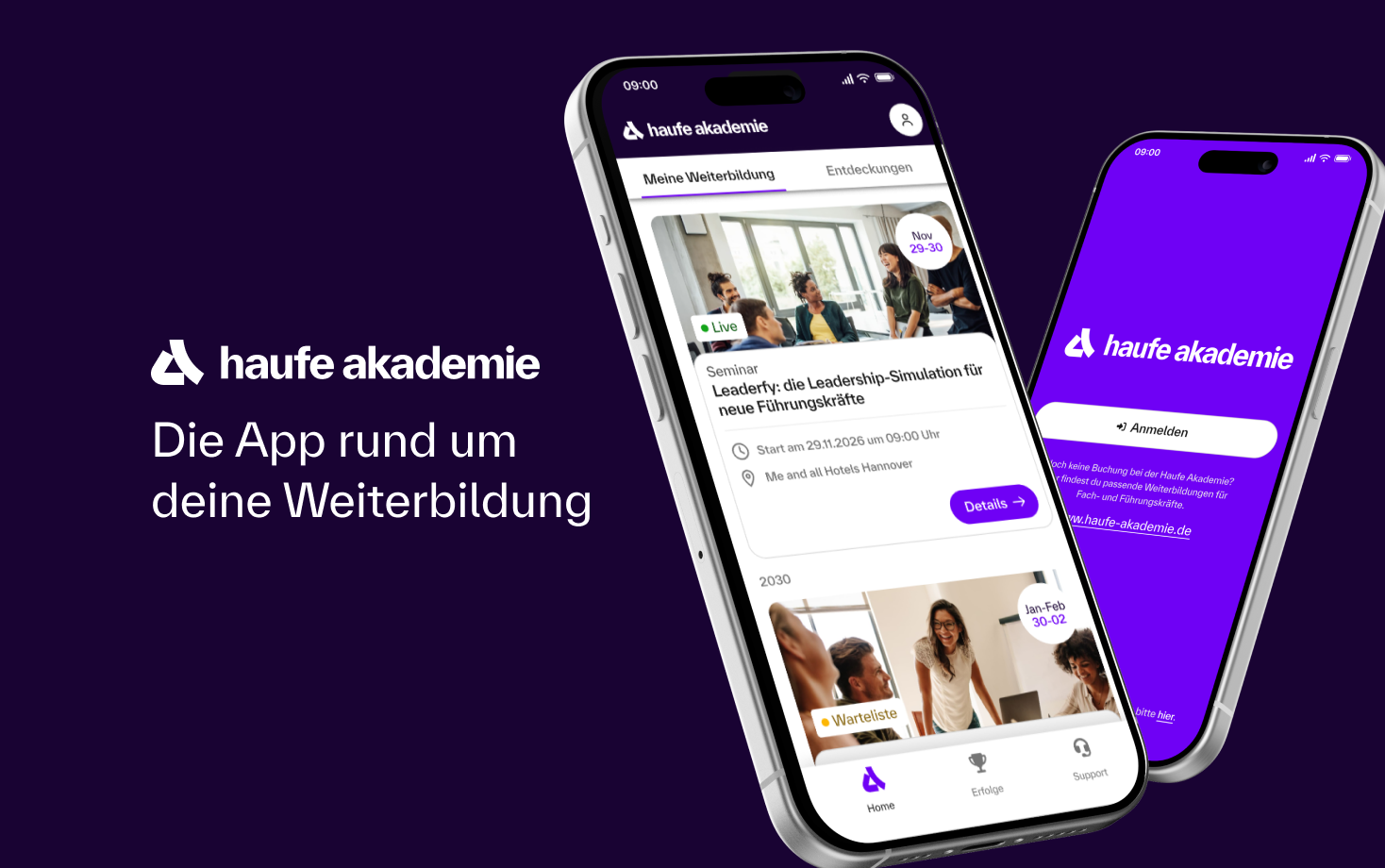
- Training app
- Business Solutions


